
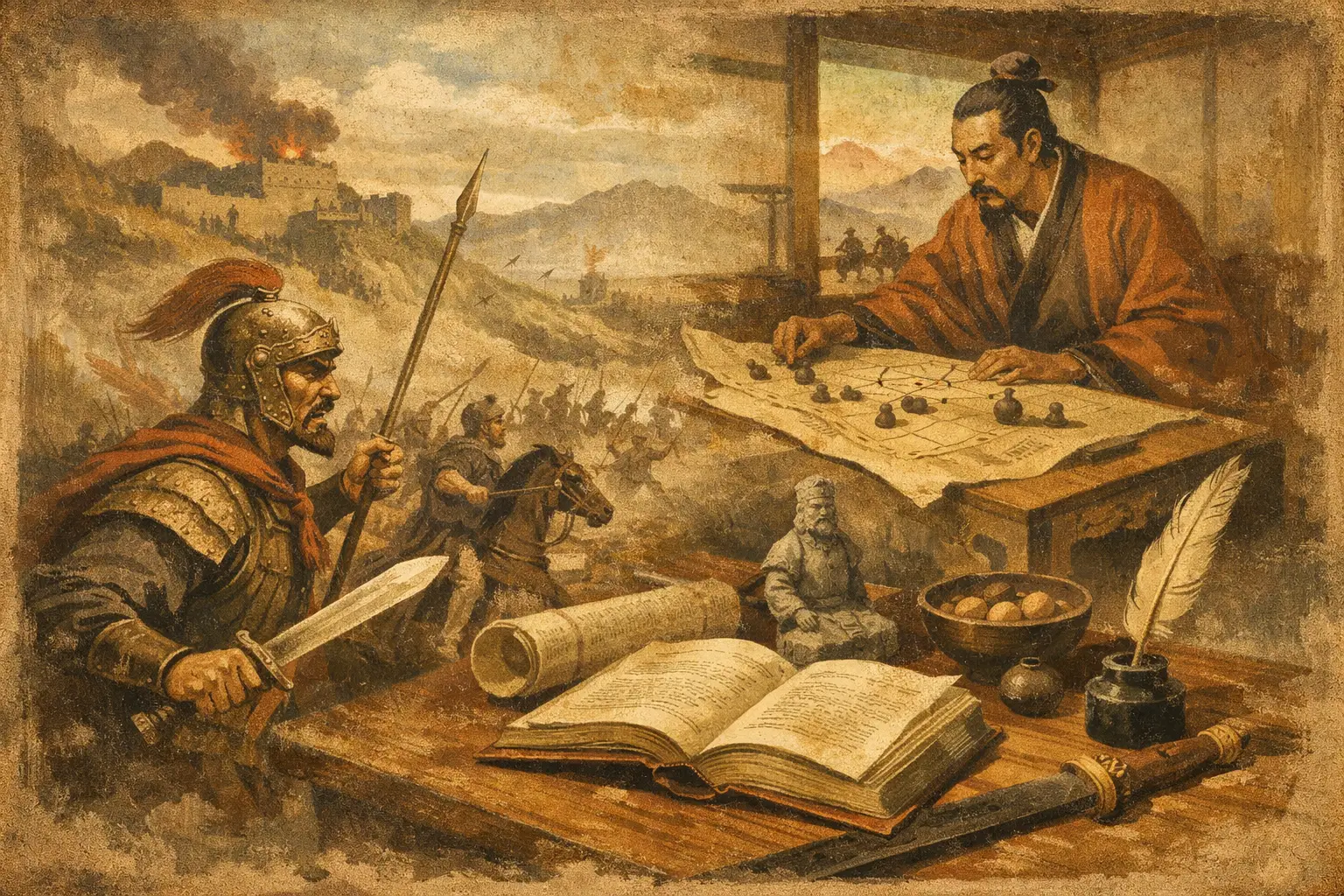
A true art of war novel does not treat strategy as a collection of clever maxims. It places strategic thought under pressure: in the mind of a commander who must act before certainty arrives, in the court of a ruler whose authority depends on judgment, and among people who will bear the cost of decisions made far from the battlefield. The enduring force of Sun Tzu’s ideas lies not in their portability to boardrooms or slogans, but in their confrontation with human limits.
Historical fiction is particularly suited to this task. It can restore the atmosphere that abstractions often remove: divided loyalties, uncertain intelligence, harsh geography, political vanity, hunger, fear, and the long silence before an irreversible order is given. Strategy becomes meaningful when it is shown as a discipline of perception rather than a performance of confidence.
Strategy Must Become Human Drama
The Art of War is often read as a manual of advantage. Its central concerns – preparation, intelligence, deception, timing, terrain, command, and restraint – can appear almost clinical when separated from narrative. A novel changes the scale of those principles. It asks who gathers the intelligence, who misreads it, who profits from a deception, and who is sacrificed when a leader mistakes force for control.
That shift matters because war is never merely an intellectual contest. Even the most disciplined plan passes through imperfect people. A messenger may arrive late. An adviser may withhold an unwelcome truth. A ruler may demand a victory that the field cannot yield. The commander who understands formations but not character has understood only part of the conflict.
For this reason, the strongest strategic fiction refuses the simple heroic arc. It does not confuse decisiveness with wisdom or conquest with order. It recognizes that a victory purchased through waste, resentment, or political blindness may weaken the state it claims to save. Sun Tzu’s emphasis on preserving strength gains its full moral and political weight when readers see what strength actually consists of: trust, food, morale, legitimacy, and the capacity to endure.
The Art of War Novel and the Problem of Power
Power in serious historical fiction is rarely located in one person alone. It moves through councils, households, military ranks, spies, rival clans, and rumors. A ruler may command armies while remaining captive to those who control access to information. A general may appear invincible while depending on scouts whose names history never records. A minor official, compelled by fear or conscience, may alter the course of a campaign more profoundly than a celebrated warrior.
This is where an art of war novel can offer more than spectacle. Its concern is not simply whether a battle is won. Its concern is how a society organizes force, how authority justifies itself, and how knowledge is transformed into action. The battlefield is one theater of conflict. The court, the marketplace, the border road, and the private chamber can be equally decisive.
Such fiction also clarifies a difficult truth: intelligence is not the same as information. Information may be abundant and still prove useless if leaders cannot distinguish signal from manipulation. Intelligence requires interpretation, patience, and the willingness to revise a cherished assumption. In narrative terms, this produces tension of a more lasting kind than combat alone. The reader watches characters act on partial knowledge, aware that a single false report or premature conclusion may reorder every later event.
Restraint Is Not Passivity
Modern adaptations of strategic thought often favor aggression because aggression is easy to dramatize. Yet one of Sun Tzu’s most demanding ideas is that unnecessary conflict is a failure of command. The best outcome is not always the loudest or most visible one. It may be the alliance preserved, the rival divided without battle, the supply line protected, or the rebellion prevented before it acquires a banner.
A novel that understands this principle must make restraint compelling. That is not a simple technical matter. If a character avoids battle without cost, restraint can look like evasion. But when restraint requires a leader to endure insult, resist political pressure, conceal strength, or accept a temporary loss to prevent a larger disaster, it becomes a form of courage.
The distinction is essential. Passivity abandons responsibility. Strategic restraint acts with a longer horizon. It recognizes that the immediate emotional satisfaction of retaliation can destroy the larger objective. This conflict between impulse and discipline is fertile ground for historical fiction because it is also a conflict within the self.
Why Setting Cannot Be Decorative
A strategic novel depends on setting not as ornament but as an active force. Terrain shapes movement. Seasons govern supplies. Distance corrupts communication. Customs determine which alliances are possible and which insults cannot be ignored. In an ancient world of fractured states and contested authority, geography is never merely scenery. A river can become a defense, a trap, a source of trade, or a boundary that exists only on a map.
The same is true of political culture. A court governed by ritual, kinship, and suspicion will produce different decisions than one ruled by commercial interest or religious authority. To write war without governance is to reduce conflict to choreography. The deeper novel understands that armies reflect the states that raise them. Their discipline, exhaustion, cruelty, and cohesion reveal the quality of the order behind them.
This is one reason historical precision matters, even when fiction necessarily imagines what the record cannot preserve. Accuracy is not a display of research. It is the foundation that allows consequence to feel real. Readers should sense that an error in protocol, a delayed harvest, or a disputed succession carries weight because the world itself has rules.
The Interior Cost of Command
The most memorable commanders in fiction are not those who always predict correctly. They are those who understand that command is a burden of judgment. They must decide when evidence is incomplete, when every available course contains harm, and when the people around them want certainty that no honest leader can provide.
A strategic protagonist therefore needs more than tactical brilliance. He or she needs an inner life shaped by responsibility. What does victory mean to someone who has seen its price? What happens when loyalty to a ruler conflicts with loyalty to the state? Can a person practice deception in war without allowing deception to hollow out private life? These questions keep strategy from becoming a cold machine.
The Shuai-jan by Ralph Srouji approaches this territory by treating Sun Tzu’s intellectual world as lived experience rather than detached doctrine. Its purpose is not to turn philosophy into a lesson plan, but to place principles of command, perception, and political order within the uncertain movement of human events.
What Readers Should Look For
Readers drawn to historical fiction, military history, or political philosophy may find that the finest works in this tradition leave them less interested in easy answers. They sharpen attention. They make the reader notice how often outcomes are determined before open conflict begins: through preparation, misdirection, alliances, discipline, and the management of fear.
The trade-off is deliberate. A novel centered on strategic depth may move with greater patience than a story built only around battle. It may linger in councils, negotiations, and private calculations. For readers seeking constant action, that measured pace can feel demanding. For those interested in the architecture of power, it is where the real action resides.
A lasting strategic novel should leave behind more than admiration for a clever commander. It should deepen the reader’s sense that judgment is formed long before the decisive moment, and that the strongest position is often built quietly, through preparation no audience sees.
Leave a Reply