
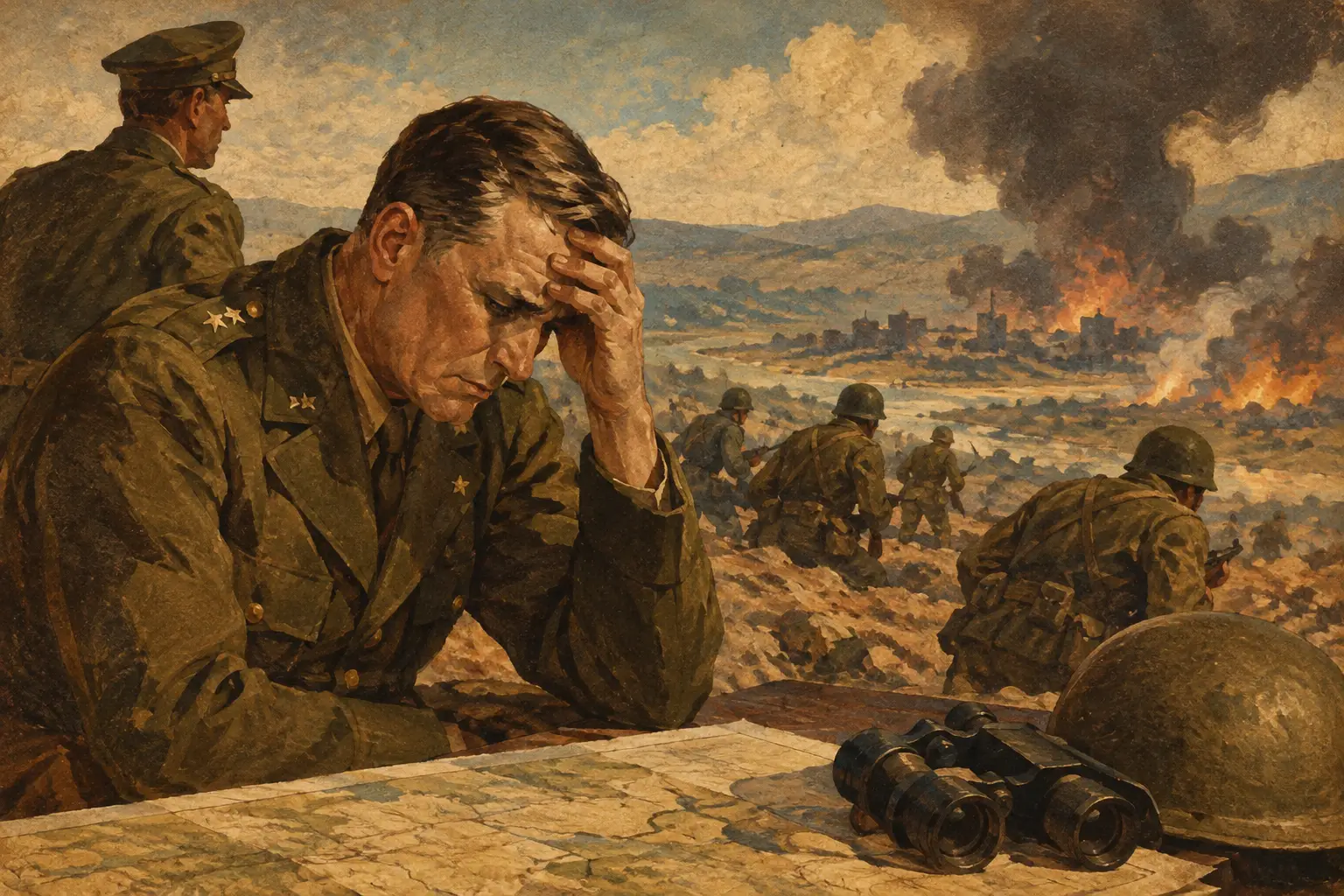
A command failure rarely begins with the sound of defeat. More often, it begins in a quiet chamber: a report dismissed, a subordinate silenced, a map read with too much confidence. How stories portray command failures matters because fiction can reveal what official accounts often conceal – not merely that an army lost, but how judgment decayed before the first formation broke.
For readers drawn to strategy, historical conflict, and the moral burden of power, these failures are not incidental reversals of plot. They are the central drama. A commander’s error radiates outward through scouts, officers, families, cities, and those ordered to carry out a decision they did not make. The strongest war stories understand that command is not a private possession. It is a responsibility exercised over other lives.
How Stories Portray Command Failures Beyond Defeat
Weak historical fiction treats failed command as a sudden mistake, often engineered to make a hero look clever by comparison. A foolish general ignores obvious advice, rides into an obvious trap, and receives his punishment. The result may be satisfying, but it teaches little about power.
More serious stories make failure gradual. They show a leader receiving incomplete intelligence, interpreting it through ambition or fear, and then surrounding himself with people who have learned that honesty carries a cost. By the time the battlefield exposes the truth, the failure has already passed through several hands. No single order explains the ruin, though one person may still bear primary responsibility for it.
This distinction matters. Command is not only the ability to issue instructions under pressure. It is the ability to construct conditions in which sound judgment can survive pressure. A ruler who rewards flattering reports, a general who treats reconnaissance as an inconvenience, or a minister who confuses secrecy with control may retain authority while losing the capacity to govern.
In narrative, this becomes visible through small acts. A messenger waits too long outside a tent. A captain edits bad news before presenting it. A commander speaks of loyalty when he means obedience. These moments establish the moral climate of an army long before its tactical collapse.
The Failure of Intelligence
Many of the most consequential command failures are failures of perception. Armies do not move through empty landscapes. They move through weather, hunger, rumor, terrain, divided loyalties, unreliable allies, and enemy deception. A commander who sees only the force directly before him has already simplified the war into a form he can no longer understand.
Stories portray this failure most effectively when intelligence is present but misread. The warning does not need to be absent. It may arrive as a scout’s uncertain observation, an intercepted message, or the troubling silence of a village that should be full of traders. What matters is the leader’s interpretation. Confidence becomes dangerous when it turns evidence into confirmation of a decision already made.
This is why the best narratives resist portraying intelligence as magical foresight. Even disciplined commanders operate with uncertainty. They must decide what can be known, what must be inferred, and what risks cannot be eliminated. The difference between wisdom and recklessness is not that one leader possesses perfect information. It is that one leader respects the limits of information.
A story grounded in strategic thought can make this tension vivid without becoming a lecture. The reader feels the pressure of competing reports and understands why delay may be prudent in one moment yet fatal in another. Preparation is not passivity. It is the discipline of refusing to gamble lives merely to preserve an image of decisiveness.
Pride Makes Bad Information Permanent
Pride is often described as a personal flaw, but in command it becomes an organizational force. A proud commander does not simply make one arrogant decision. He creates an environment where others must protect his self-image. Officers begin to report what he can bear to hear. Advisers learn to wrap warnings in praise. Eventually, the command structure becomes a machine for converting reality into reassurance.
Fiction is especially suited to exposing this process because it can move between the commander’s conviction and the subordinate’s dread. The general may believe he is projecting steadiness. The lieutenant may see that no one is permitted to question him. Both perspectives can be true, and the gap between them is where disaster grows.
Authority Without Control
Command failures are also failures of coordination. An army may have brave soldiers, experienced officers, and an impressive chain of authority, yet still fail because its parts no longer act from a shared understanding of the situation. One wing advances on yesterday’s plan while another waits for orders that cannot arrive. A political leader demands a symbolic victory while the field commander sees only an untenable position.
Such scenes reveal a hard truth: authority is not control. Orders may be absolute in language but impossible in execution. A commander who does not understand distance, fatigue, local conditions, or the motivations of his officers is not truly commanding. He is making declarations and hoping the world will obey.
Historical fiction gains depth when it attends to this friction. The rider who cannot cross a flooded road, the unit sent forward without provisions, and the ally who interprets an agreement differently are not decorative details. They show why strategy cannot remain abstract. Every intention must pass through human beings, material limits, and time.
In this sense, command failure is often administrative before it is martial. The battlefield merely makes the neglected structure visible. A force that cannot feed itself, communicate clearly, or distinguish discipline from humiliation will eventually discover that courage cannot repair every weakness.
The Moral Weight of the Decision
The most enduring stories do not use failure only to judge leaders. They ask what leadership costs those beneath it. A commander may survive a disastrous campaign and retain his rank. The soldier who followed the order may not survive the afternoon. That asymmetry gives command its moral gravity.
A serious narrative should not reduce subordinates to anonymous victims, however. They have judgment, fear, loyalty, resentment, and agency of their own. Some recognize failure early and must decide whether to object. Some obey because they believe cohesion matters more than personal certainty. Some exploit a commander’s blindness for advancement. Their choices do not erase the leader’s responsibility, but they complicate the human chain of consequence.
This is one reason stories of command failure can be more penetrating than accounts built around victory. Victory often creates a clean line between competence and reward. Failure exposes what success can hide: chance, compromised information, political pressure, and the limits of even gifted leaders. It also tests whether a commander can accept responsibility without turning defeat into an accusation against everyone else.
In The Shuai-jan, the strategic world associated with Sun Tzu gains force precisely because principles of preparation, intelligence, and restraint must be lived by people under pressure. Strategy becomes meaningful when its absence has a face, a consequence, and a memory.
Why Failure Creates the Better Strategic Story
A triumphant commander can appear wise simply because events favored him. A failed commander forces the reader to inspect the process. Was the plan unsound from the beginning? Did political necessity distort military judgment? Did the leader mistake speed for initiative, severity for discipline, or secrecy for insight?
The answers should not always be simple. Some failures arise from negligence; others from choosing between two terrible options. A leader who retreats may preserve an army and lose a kingdom. A leader who fights may save political legitimacy and destroy the force needed for the next campaign. Stories become credible when they recognize that restraint is not always rewarded and boldness is not always vanity.
Yet complexity must not become an excuse. Circumstances constrain command, but they do not abolish responsibility. The question is not whether a leader could control every outcome. No leader can. The question is whether he studied the conditions before him, invited unwelcome truth, prepared for reversal, and understood what his decision would demand from others.
That is the lasting value of command failure in fiction. It trains the reader to look beyond the decisive charge or the final proclamation and toward the quieter disciplines that determine whether power holds. When a story makes us attentive to the ignored report, the weakened supply line, and the adviser afraid to speak, it offers more than a tale of defeat. It offers a sharper way to recognize the cost of being wrong before the cost is paid by someone else.
Leave a Reply