
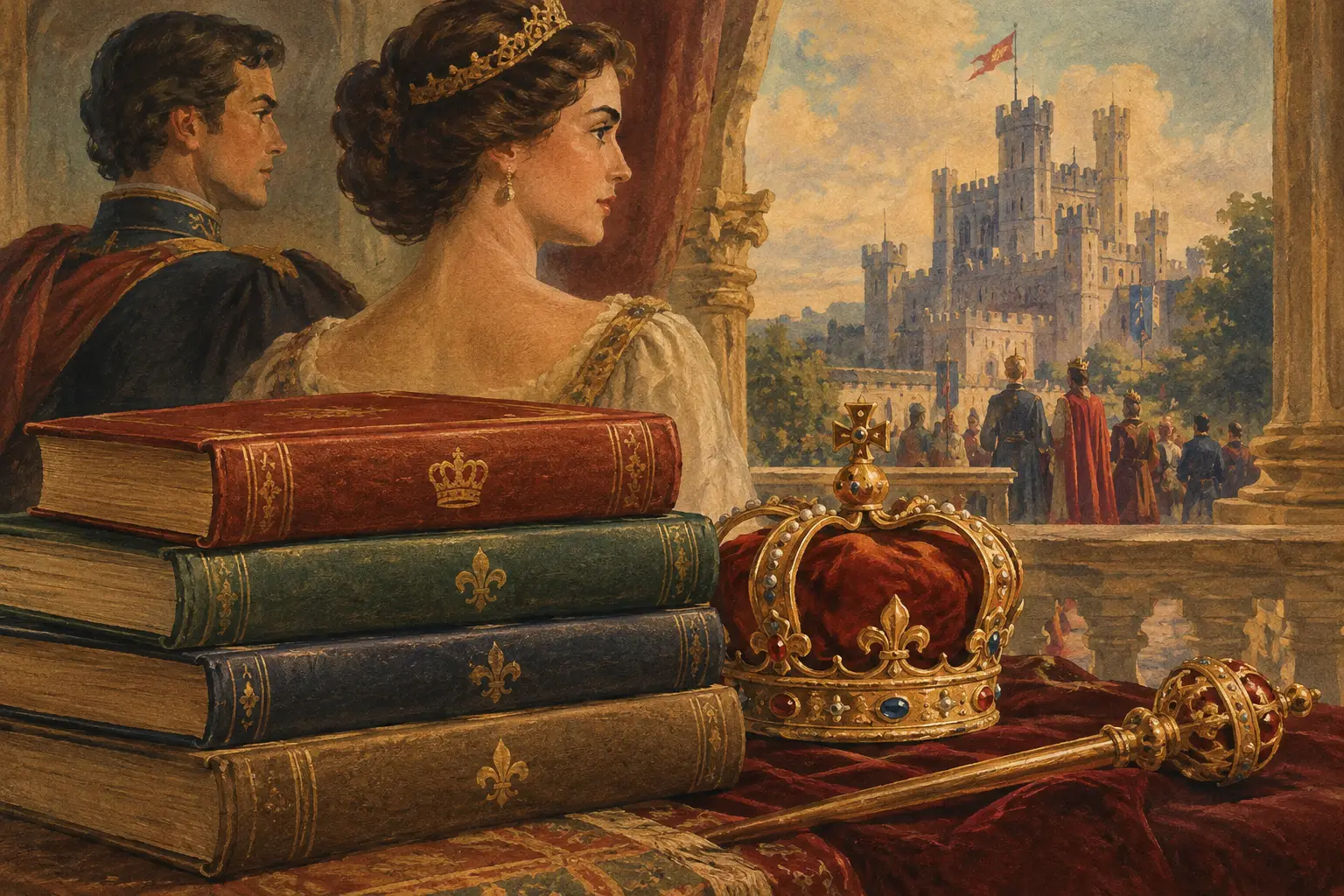
A throne is never merely a chair. It is a claim upon armies, laws, families, memory, and fear. The best novels about royal succession understand that an heir does not simply inherit authority. He or she inherits a structure of competing interests, old injuries, private ambitions, and public expectations. The decisive conflict often begins long before a crown changes hands.
For readers drawn to strategy, governance, and the moral pressure of command, succession fiction offers more than courtly spectacle. It reveals how power is preserved, transferred, contested, or squandered. The finest works make legitimacy feel unstable because, in political life, it usually is.
What Makes a Royal Succession Novel Endure
A compelling succession novel does not reduce conflict to the question of who deserves to rule. Deserving is rarely decisive. Bloodline may establish a claim, but intelligence, military force, religious sanction, reputation, and timing determine whether that claim survives contact with reality.
The novels below differ in period and style. Some are rigorously historical; others use invented kingdoms to examine the same ancient mechanics. What joins them is their seriousness about the cost of power. In each, the private life of a ruler becomes a matter of state.
12 Best Novels About Royal Succession
1. I, Claudius by Robert Graves
Robert Graves gives imperial Rome the intimacy of a poisoned household. Claudius, dismissed by his relatives as physically weak and politically harmless, watches the Julio-Claudian dynasty devour itself through assassination, manipulation, and calculated marriage. His apparent insignificance becomes his protection.
The novel is essential because it treats succession as an intelligence problem. Those who advertise ambition become targets; those who understand the court’s hidden currents may outlast stronger rivals. Graves also captures a bitter truth of inherited power: the system selects not necessarily the best ruler, but the survivor best positioned after everyone else has made their move.
2. The Accursed Kings by Maurice Druon
Few historical series renders dynastic collapse with greater severity. Set in fourteenth-century France, Maurice Druon’s sequence begins with the ruin of the Capetian line and follows the rivalries, debts, betrayals, and disputed inheritances that prepare the ground for the Hundred Years’ War.
Its great strength is structural. A royal succession is not presented as an isolated family quarrel but as a crisis that reaches into finance, noble alliances, foreign policy, and popular unrest. Every marriage carries a diplomatic implication. Every death alters the balance. Readers interested in how a state weakens from its center will find Druon exceptionally clear-eyed.
3. Wolf Hall by Hilary Mantel
Hilary Mantel’s Thomas Cromwell moves through Tudor England with an administrator’s grasp of leverage. Henry VIII’s need for a male heir is not merely domestic dissatisfaction. It becomes the engine of religious rupture, legal reinvention, and a new arrangement between crown and country.
Wolf Hall is less concerned with a conventional contest between heirs than with the machinery built to secure succession before uncertainty hardens into disaster. Mantel shows that power belongs partly to those who can redefine the rules around it. Cromwell’s gifts are preparation, observation, and the disciplined conversion of information into advantage.
4. The Mirror and the Light by Hilary Mantel
The final volume of Mantel’s Cromwell trilogy turns triumph into exposure. The king has his son, but the kingdom remains unsettled, and the minister who helped construct a new order must now survive its consequences. A succession secured in theory can remain dangerous in practice.
This is one of the best novels about royal succession for readers who value political nuance over simple villainy. Mantel understands that no adviser is indispensable forever. Institutions created to serve a ruler can become instruments against the people who shaped them. The novel’s tension lies in that reversal.
5. The Sunne in Splendour by Sharon Kay Penman
Sharon Kay Penman reconsiders Richard III within the violence of the Wars of the Roses. The result is an expansive novel of contested inheritance, shifting loyalties, and reputations made or destroyed by the victors. Penman does not ask readers for blind allegiance. She asks them to see how historical judgment is formed amid propaganda and civil war.
Its succession conflict has unusual emotional force because the rival claims are embedded in kinship. Brothers, cousins, and children become political assets before they can become private selves. The novel is especially strong on the tragedy of a realm in which every settlement produces the next grievance.
6. The Lady of the English by Elizabeth Chadwick
The struggle between Empress Matilda and King Stephen demonstrates how fragile hereditary right can become when custom resists the heir. Elizabeth Chadwick portrays the civil war known as the Anarchy through a broad cast, giving particular attention to Matilda’s claim and the political resistance it provokes.
This is a valuable choice because it refuses the false comfort of legal certainty. Matilda possesses a powerful hereditary argument, yet a claim requires enforcement, allies, and a public capable of accepting its implications. Chadwick makes clear that succession is governed by precedent only until fear or opportunity makes precedent inconvenient.
7. A Game of Thrones by George R. R. Martin
George R. R. Martin’s first Westeros novel begins with a royal court already compromised by secrecy. When King Robert’s health and authority fail, the question of succession exposes a network of concealed parentage, regional interests, military loyalties, and personal vendettas.
Its fantasy setting permits Martin to sharpen the political logic without softening it. Honor matters, but honor without situational awareness can be fatal. Force matters, but force without legitimacy generates resistance. The novel’s lasting appeal rests in this pressure between principle and survival, though readers should know that the larger series remains unfinished.
8. The Grace of Kings by Ken Liu
Ken Liu’s sweeping fantasy begins after an empire’s collapse, when two very different men rise against a failing order. The question is not only who will rule next, but what form a new political order should take after conquest. Friendship, ideology, and ambition are tested by the demands of statecraft.
Liu is attentive to logistics, narrative control, and the uses of myth. A ruler must win battles, but must also persuade others that his victory was inevitable, just, or divinely favored. The Grace of Kings is particularly rewarding for readers interested in how legitimacy is manufactured after a revolution.
9. The Once and Future King by T. H. White
T. H. White’s Arthurian novel treats kingship as an ethical burden rather than a prize. Arthur’s claim may be marked by the sword in the stone, but divine or magical sanction cannot resolve the deeper problem: how can a ruler impose justice without becoming captive to force?
Succession enters the story through Mordred, whose existence exposes the vulnerabilities in Arthur’s ideal order. The novel remains powerful because it recognizes that institutions depend on character, while character itself is shaped by fear, love, resentment, and education. No kingdom can be made secure by a symbol alone.
10. Romance of the Three Kingdoms by Luo Guanzhong
This foundational Chinese classic opens amid the decline of the Han dynasty, when imperial authority remains visible but no longer commands obedience. Warlords, ministers, and rival houses compete beneath the language of restoration, each asserting a version of legitimate rule.
The novel is vast, episodic, and strategic in its outlook. Its commanders weigh terrain, morale, deception, supply, and the psychology of opponents. Yet its deeper question concerns the Mandate of Heaven: when does a dynasty lose the right to rule, and who may credibly claim to replace it? Its scale rewards patient readers.
11. She Who Became the Sun by Shelley Parker-Chan
Shelley Parker-Chan reimagines the rise of the Ming dynasty through a protagonist who seizes an identity, a future, and eventually a claim to historical significance. The novel is not a conventional royal-family chronicle, but it is deeply concerned with dynastic succession and the political meaning of destiny.
Its distinctive contribution is its attention to desire. Ambition is not treated as a single-minded virtue or vice. It is a force that can produce discipline, reinvention, cruelty, and extraordinary clarity. The novel asks whether a person can make a mandate through will, or whether power always requires others to believe in the story being told.
12. The Dragon Waiting by John M. Ford
John M. Ford’s alternate-history novel places a divided Europe under the shadow of Byzantine power and turns the Wars of the Roses into a dense contest of intelligence, identity, and competing loyalties. It is demanding, but its complexity is earned.
Ford understands that succession disputes are never confined to the bloodline. They draw in foreign powers, religious factions, spies, exiles, and people who must decide which future they can live with. For readers who prefer their political fiction layered, morally unsettled, and resistant to easy resolution, it is a formidable final choice.
Read for the Decision Beneath the Crown
The strongest succession novels leave behind more than a roster of betrayals. They clarify that leadership is tested before the decisive hour: in what a claimant notices, whom a ruler trusts, which risks are accepted, and which victories are refused. A crown may pass by blood, force, or ceremony. Authority endures only when judgment can bear the weight placed upon it.
Leave a Reply