
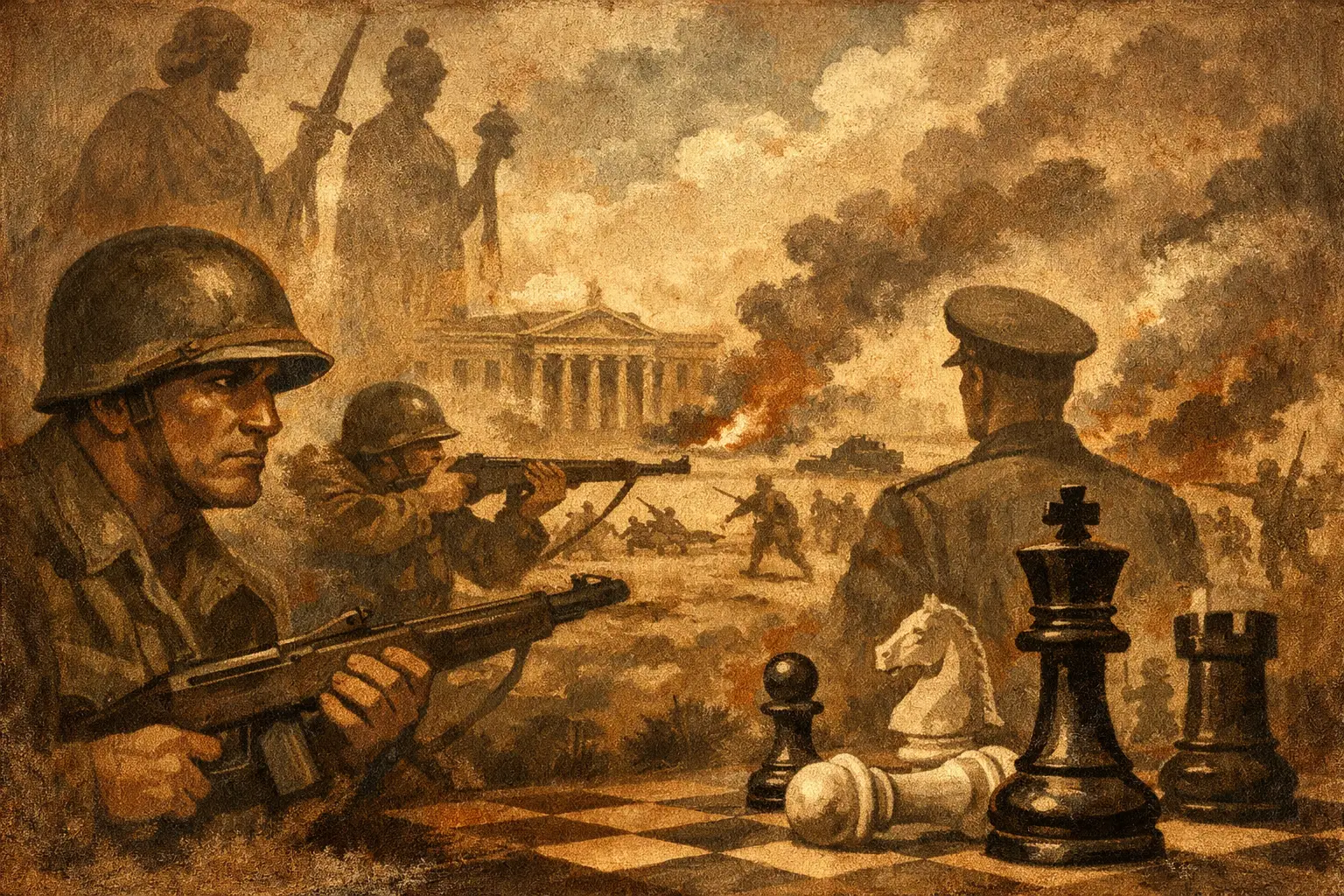
A commander studies a map before a battle, but the map cannot show him the hunger in his soldiers, the fear in an ally’s voice, or the private ambition of the minister who supplied his army. War begins with terrain and numbers, yet it is decided within human beings. Philosophical war fiction enters that interior territory. It treats conflict not merely as an event of steel, movement, and victory, but as a sustained examination of judgment under pressure.
For readers drawn to history, strategy, and leadership, this distinction matters. A battle can be reconstructed with remarkable precision and still fail to explain the thing that makes it tragic: the decision to begin it, the confidence that sustains it, and the lives altered by one person’s estimate of necessity. Fiction has the freedom to place the reader inside those calculations, where doctrine meets uncertainty and power exposes character.
War as a Test of Thought
War fiction becomes philosophical when it refuses to accept violence as self-explanatory. It asks what violence is for, who authorizes it, and what it does to the people who use it. These questions do not weaken a story’s sense of action. They give action consequence.
A general may achieve an immaculate tactical result and still reveal a failure of political imagination. A ruler may seek peace and nevertheless create the conditions for a longer conflict through hesitation, vanity, or poor intelligence. The central drama is often not whether a character is brave enough to fight. It is whether that character can perceive reality before reality becomes irreversible.
This is where war and philosophy belong together. Philosophy, at its most demanding, tests assumptions. War makes assumptions expensive. A mistaken reading of an enemy, a misplaced confidence in fortification, or an inability to govern newly conquered territory can turn apparent strength into ruin. The battlefield is therefore not only a site of collision. It is a proving ground for ideas about order, authority, loyalty, and human nature.
The Difference Between War Fiction and Philosophical War Fiction
Much war fiction is concerned with experience: the terror of combat, the fellowship of soldiers, the chaos of survival, or the distance between those who command and those who obey. These are enduring subjects, and they deserve serious treatment. Philosophical war fiction includes them, but it presses further. It examines the principles beneath the experience.
What is the obligation of a commander to the people entrusted to him? Is deception a mark of corruption, or a necessary instrument of survival? When does discipline preserve an army, and when does it become a machine for suppressing conscience? Can a state claim moral purpose while treating its citizens as material for conquest?
Such fiction does not require a character to recite abstract arguments. Its philosophy should live in the pressure of the plot. A king who rewards loyalty over competence produces one kind of war. A spy who learns that truth can destabilize a fragile peace confronts another. A commander who saves his army by abandoning a city must live with the difference between strategic success and moral innocence.
The result is not a lecture dressed as a novel. It is a narrative in which ideas are tested through irreversible choices.
Strategy Is Never Only Strategy
Strategic thought is often mistaken for cold calculation. In its shallow form, it can become exactly that: an appetite for control detached from any account of human cost. Yet the deeper tradition understands strategy as a discipline of perception. It demands attention to conditions, timing, morale, information, and the limits of force.
This is why the most compelling strategic fiction does not glorify the commander who charges first. It is more interested in the leader who recognizes what must be known before action begins. Intelligence is not simply espionage. It is the ability to see beyond appearances, to understand the motives of allies, the vulnerabilities of institutions, and the forces already moving beneath public events.
Sun Tzu’s enduring power rests partly on this insight. Conflict is not won by force alone, because force is only one expression of power. Preparation, deception, diplomacy, supply, morale, terrain, and perception may determine the outcome before armies ever meet. When these concepts are dramatized rather than merely explained, they become human. A delayed message can alter a campaign. A misjudged envoy can make peace impossible. A ruler’s need to appear strong can trap a nation in a war it cannot afford.
The strategic novel therefore asks a demanding question of readers: what do you see before events compel you to see it?
The Moral Weight of Restraint
Popular stories often make decisive action look inherently virtuous. The leader who hesitates is weak; the warrior who refuses violence is naïve; the ruler who compromises has betrayed principle. History offers a harsher lesson. Action can be necessary, but it is not automatically wise. A leader’s capacity for restraint may be the highest form of command.
Restraint does not mean passivity. It can mean refusing a battle designed by the enemy, withholding force until its purpose is clear, or accepting temporary humiliation to preserve a larger political order. These choices carry their own danger. An army may interpret restraint as weakness. Rivals may exploit it. A population suffering under threat may demand immediate retribution.
Philosophical war fiction is especially suited to this tension because it can show both sides of the decision. It can make readers feel the anger that demands retaliation while exposing the hidden costs of satisfying it. It can show why peace is difficult not because peace lacks virtue, but because peace requires discipline from people who have learned to think of violence as proof of seriousness.
The most mature war narratives do not pretend that every conflict can be avoided. They recognize that some threats demand force. But they insist that force must answer to a purpose greater than the exhilaration of victory. Without that purpose, conquest becomes motion without direction.
Governance After the Battle
A war story that ends at triumph often stops before its most revealing question. What happens after the gates are breached, the rival is defeated, and the banners are raised?
Victory creates obligations. Territory must be governed. Former enemies must be controlled, reconciled, or both. Soldiers who were necessary in war may become dangerous in peace. A ruler who expanded authority through emergency powers may discover that such powers do not willingly disappear. The skills required to seize power are not always the skills required to sustain a just order.
This is one reason historical settings give philosophical fiction unusual force. They allow readers to encounter political problems at a distance while recognizing their permanence. The names of kingdoms change. The instruments of violence change. Yet leaders still confuse possession with legitimacy, information with wisdom, and fear with loyalty.
In a work such as The Shuai-jan, strategic thought gains its full dramatic meaning when it is bound to this larger question of governance. The point is not to admire cunning in isolation. It is to ask whether intelligence can serve order, whether authority can remain disciplined, and whether power can avoid devouring the purpose for which it was first assembled.
Why This Form Endures
Readers return to serious war fiction because war concentrates ordinary human failures and virtues. Pride becomes policy. Fear becomes command. Loyalty becomes a weapon or a refuge. One person’s private grievance can become a public catastrophe.
The philosophical dimension prevents these stories from becoming spectacles of suffering or celebrations of domination. It holds every triumph under scrutiny. It reminds us that the victorious commander may be less free than the defeated soldier, that a clean strategy may produce an unclean peace, and that the greatest failure can occur long before the first weapon is raised.
For readers who value leadership, the form offers no easy instruction. It offers something more useful: a disciplined encounter with consequence. It asks us to consider what we would notice, what we would ignore, and what price we would permit others to pay in the name of security.
The finest philosophical war fiction leaves the reader not with a hunger for battle, but with a sharper respect for the rare intelligence that prevents one.
Leave a Reply