
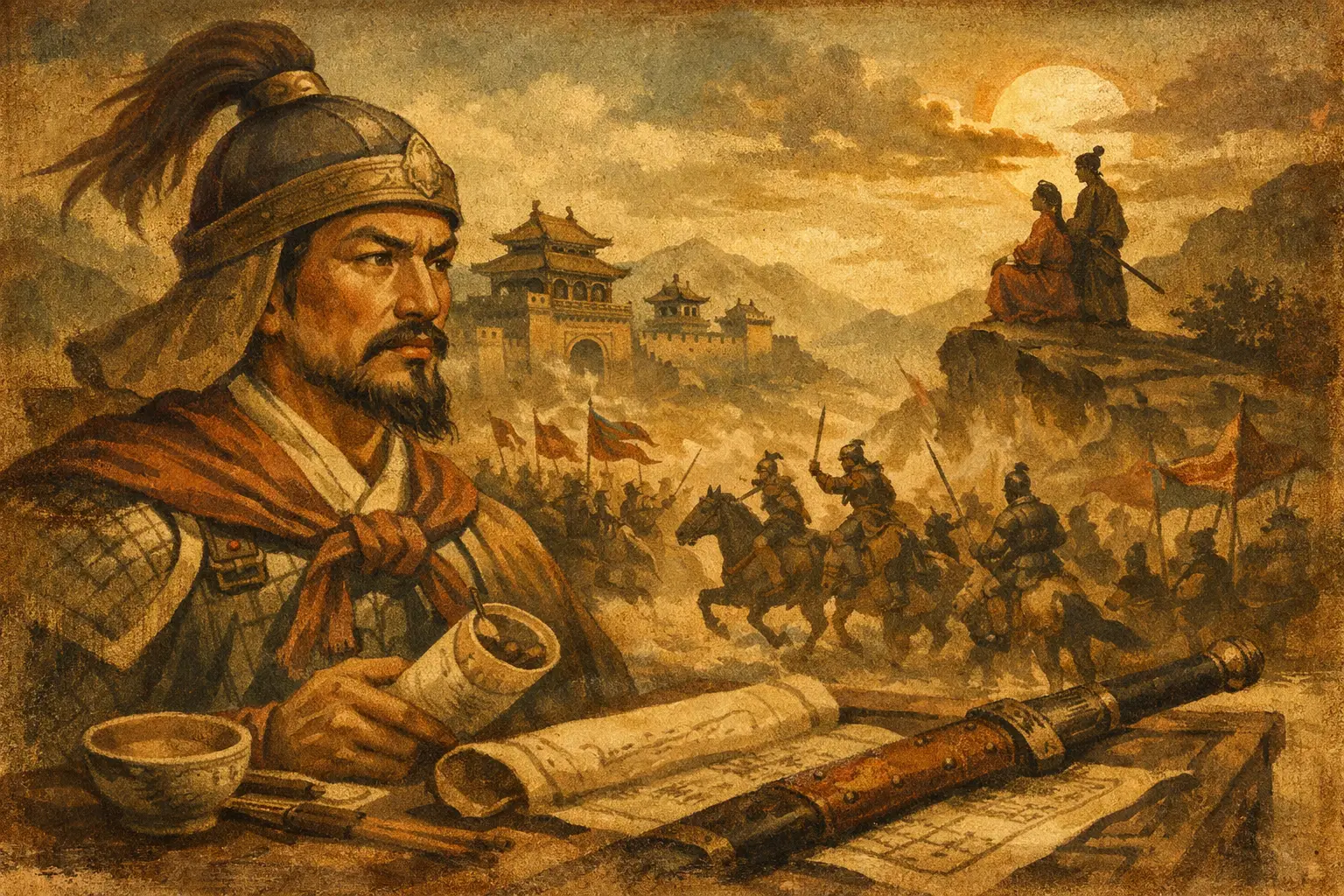
A serious sun tzu historical fiction novel cannot survive on recognition alone. The name carries weight, but weight is not narrative. Too many books approach Sun Tzu as a symbol first and a human presence second, reducing a complex strategic mind to a sequence of quotations, battlefield aphorisms, and convenient wisdom. That approach may flatter familiarity, but it rarely produces fiction of consequence.
To write or choose such a novel well, one must begin elsewhere – with the conditions that would have made a mind like this necessary. The late Spring and Autumn period and the violent transitions that followed were not abstract theaters for military brilliance. They were worlds of unstable courts, competing states, fragile legitimacy, intelligence networks, logistical strain, and rulers forced to measure ambition against survival. In that environment, strategy was not an accessory to war. It was a method of enduring history.
Why a sun tzu historical fiction novel is difficult
The central problem is straightforward. Sun Tzu is famous for ideas, not for a universally familiar life story in the way later conquerors or emperors are. His reputation has expanded far beyond the surviving historical record. That creates a structural challenge for fiction. The novelist must build a convincing human drama around a figure whose cultural afterlife is larger than his documented biography.
This is precisely why the form can be so compelling when handled with discipline. A Sun Tzu novel should not merely animate a celebrated strategist. It should dramatize the conditions under which strategic thought becomes necessary, costly, and morally charged. The best version of this kind of fiction asks not only what Sun Tzu knew, but what he had to observe, suffer, conceal, and judge in order to know it.
That means the novel cannot be sustained by battle scenes alone. War, in this frame, is the visible expression of prior decisions. A commander’s insight is shaped long before armies move – in court debates, intelligence failures, misread intentions, supply constraints, diplomatic maneuvers, and acts of restraint that never become legend. A serious novel understands that strategy begins before conflict and continues after apparent victory.
The difference between doctrine and drama
Readers often come to Sun Tzu through maxims. They remember compressed lines about deception, preparation, timing, or winning without fighting. But fiction cannot function as a storage case for quotations. If it tries, the result feels instructional rather than lived.
Drama requires friction. It requires uncertainty, competing loyalties, imperfect information, and decisions that close one path as they open another. In historical fiction, strategic principles only gain force when they emerge from circumstance. A line about knowing the enemy means little unless the reader feels the cost of misjudgment. A claim about supreme excellence means little unless the narrative makes plain how difficult it is to preserve a state without exhausting it.
This is where the strongest novels separate themselves from pseudo-philosophical pageantry. They allow ideas to arise through scenes of pressure. A ruler hesitates. A general sees what others do not. A court mistakes silence for weakness. A messenger arrives too late. An ally proves useful but dangerous. Under such conditions, strategy stops being abstract elegance and becomes a contest between perception and consequence.
History matters more than atmosphere
A convincing sun tzu historical fiction novel must respect period reality, but not in the shallow sense of decorative authenticity. Costumes, weapons, and palace settings are not enough. Historical seriousness means understanding what power looked like at the time and how fragile its instruments often were.
Ancient Chinese statecraft was inseparable from ritual legitimacy, agricultural capacity, noble rivalries, local geography, and the persistent instability of human allegiance. A strategist did not operate in a vacuum. He operated within systems that could distort, resist, or weaponize his insight. Historical fiction becomes thin when it treats strategy as the triumph of individual genius over passive circumstances. In truth, strategic intelligence is always constrained by institutions, personalities, and material limits.
This is also why moral simplification weakens the form. A novel centered on Sun Tzu should not present war as a stage for clean heroism. It should confront the harder proposition that order often depends upon choices made under duress, and that prudent leadership may require actions that remain ethically unsettled. Restraint, deception, discipline, surveillance, and sacrifice are not decorative themes here. They are part of the political anatomy of survival.
Character is the test
The greatest risk in a Sun Tzu novel is turning the protagonist into an oracle. Omniscient characters do not create tension. They merely demonstrate superiority. Readers who care about history, leadership, and philosophy expect more than that.
A compelling Sun Tzu must possess command without becoming inert. He should be capable of observation, discipline, and strategic patience, yet still remain vulnerable to isolation, political hostility, misinterpretation, and the burden of seeing farther than those around him. Intellectual authority becomes interesting only when it operates under pressure.
Supporting characters matter just as much. The ruler, ministers, rivals, scouts, envoys, and soldiers should not exist merely to validate the strategist’s brilliance. They should embody competing visions of power. One may value prestige over endurance. Another may seek immediate victory at long-term cost. A third may understand administration but not war. Through such contrasts, the novel becomes an argument about governance rather than a shrine to genius.
The finest historical fiction also recognizes that a strategic mind is not purely martial. It is administrative, psychological, and political. It understands appetite, fear, timing, morale, reputation, and the uses of silence. Characterization should therefore reveal not only how a figure commands troops, but how he reads men, institutions, and danger.
What readers should look for in a Sun Tzu historical fiction novel
For readers seeking substance rather than branding, the question is not simply whether a book includes Sun Tzu. The question is what the novel believes strategy is.
If strategy is treated as a chain of clever battlefield reversals, the work may entertain, but it will likely feel narrow. If it understands strategy as the disciplined management of uncertainty across war, governance, intelligence, and human ambition, then it enters more serious territory. That is where historical fiction can do something unusually valuable. It can show the inner weather of decision-making in a way no summary of principles can.
Readers should also attend to the book’s treatment of pace. A thoughtful novel in this domain will not rush toward constant spectacle. It will know when to slow down for observation, council, planning, or concealed movement. That restraint is not a defect. It is often the mark of confidence. Strategic fiction should feel shaped by timing, not merely populated by action.
Language matters as well. The prose need not imitate classical texts, but it should possess a degree of composure. A novel about strategic thought should not sound careless. Clarity, precision, and tonal control help establish the authority such material requires.
Why this form still matters
Sun Tzu persists because his thought addresses permanent conditions of power. Human beings still misread intentions, overextend resources, mistake force for control, and confuse motion with progress. Institutions still fail through vanity, delay, and internal fracture. Leaders still need judgment before they need slogans.
Historical fiction gives these truths body. It restores contingency to ideas that are too often repeated as if they emerged complete and bloodless from the mind of a detached sage. In narrative, one sees what doctrine usually suppresses: the exhaustion behind preparation, the political danger behind candor, the uncertainty beneath command, and the price of every decision that avoids disaster by means no chronicler celebrates.
That is why the form remains powerful for contemporary readers, especially those drawn to leadership, military history, and philosophy. It offers neither academic distance nor simplistic inspiration. Instead, it stages thought inside consequence.
A work such as The Shuai-jan matters if it understands this burden. To reinterpret The Art of War through fiction is not merely to retell old wisdom in dramatic costume. It is to ask what kind of world produces such wisdom, and what kind of person can bear its implications.
A worthy Sun Tzu novel leaves the reader with more than admiration for intelligence. It leaves a sharper sense that discipline is costly, foresight is lonely, and power belongs not to the loudest actor in the field, but often to the one who has understood the field before others knew they stood within it.
Leave a Reply