
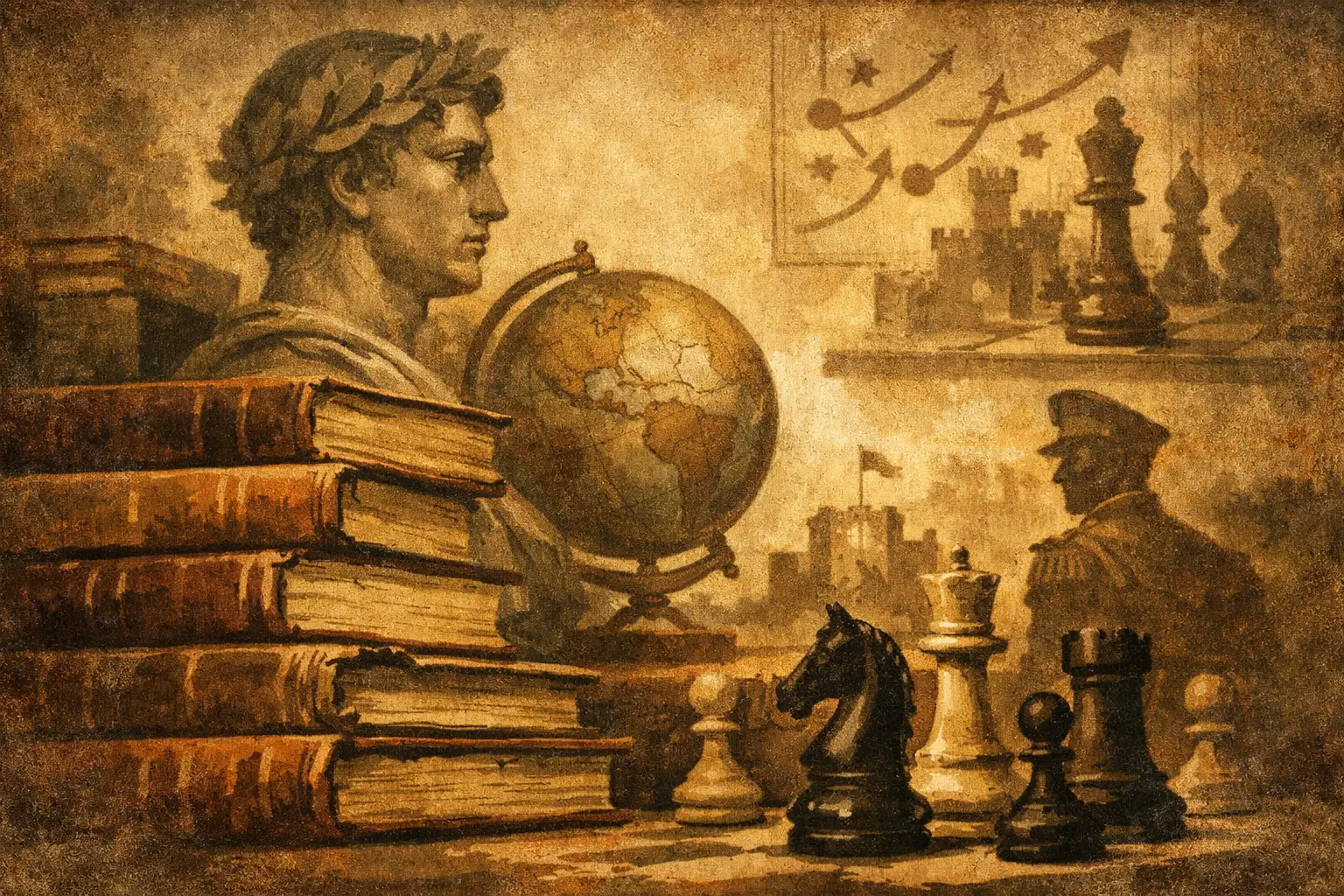
Power is often mistaken for force because force is visible. Strategy begins where visibility ends: in timing, information, discipline, perception, and the ability to shape a rival’s choices before open conflict becomes necessary. The finest books about strategy and power do not merely explain how people win. They reveal why capable leaders fail, why institutions decay, and why restraint can be more decisive than aggression.
This is not a reading list for those seeking shortcuts to dominance. It is for readers who understand that power is a condition to be studied: political, military, psychological, and moral. Some of these works are manuals. Others are histories or novels. Together, they form a demanding education in the costs of command.
12 Books About Strategy and Power Worth Reading
1. The Art of War by Sun Tzu
Few books have been quoted so often and read so selectively. Sun Tzu’s great subject is not battle in the narrow sense, but the preservation of strength through superior judgment. He treats intelligence, terrain, morale, deception, and preparation as parts of a single system.
Its brevity is deceptive. Read slowly, The Art of War becomes less a collection of maxims than an argument against impulsive leadership. The commander who seeks battle for its own sake has already surrendered the larger contest.
2. The Prince by Niccolo Machiavelli
Machiavelli remains unsettling because he refuses to flatter political virtue. In The Prince, power is unstable, fortune is unreliable, and leaders are judged by outcomes as much as intentions. His concern is not cruelty as an ideal, but the hard question of how a ruler secures a state amid disorder.
The book is often treated as a defense of ruthlessness. That reading is too simple. Machiavelli is more useful when read as an observer of political risk: legitimacy must be maintained, enemies must be understood, and indecision can become its own form of violence.
3. The History of the Peloponnesian War by Thucydides
Thucydides offers no reassuring belief that reason naturally governs nations. His history of Athens and Sparta shows how fear, interest, honor, and miscalculation can drive powerful states toward ruin.
The Melian Dialogue receives much attention, and rightly so, but the greater lesson lies in the work’s accumulation of failures. Democratic confidence becomes overreach. Debate becomes performance. Military power outruns political clarity. For anyone studying the strategic consequences of pride, this is indispensable.
4. The Thirty-Six Stratagems
This classical Chinese collection is less a unified philosophical work than a compressed catalog of indirect action. Its stratagems concern misdirection, momentum, alliance, retreat, and the manipulation of appearances. Several are starkly opportunistic; that is part of their value.
The reader should not treat them as ethical instructions. Their purpose is diagnostic. They sharpen the ability to recognize when another party is creating a false choice, concealing weakness, or using disorder as cover for a more deliberate move.
5. On War by Carl von Clausewitz
Clausewitz is difficult because he is serious about uncertainty. He rejects the fantasy that war unfolds according to clean plans, insisting instead on friction: the countless errors, delays, fears, accidents, and misunderstandings that distort action.
His famous claim that war is politics by other means is often repeated without its full weight. It means military action cannot be judged apart from political purpose. A campaign may succeed tactically and still fail strategically if its leaders do not know what settlement, condition, or order they are trying to create.
6. The Book of Five Rings by Miyamoto Musashi
Musashi writes from the discipline of individual combat, yet his concerns extend beyond the duel. He studies rhythm, posture, preparation, adaptability, and the danger of becoming attached to a single method.
This is a useful corrective to strategy books that remain entirely abstract. Judgment depends on trained perception. Under pressure, a leader does not rise to a theory; he falls back on the quality of his practice. Musashi’s severity is therefore practical rather than ornamental.
7. The Federalist Papers by Alexander Hamilton, James Madison, and John Jay
Power is not only seized or wielded. It is also designed, divided, delayed, and constrained. The Federalist Papers examines the strategic architecture of republican government: competing interests, faction, representation, executive energy, and the difficulty of sustaining liberty at scale.
Readers interested in governance will find a crucial distinction here. A durable political order cannot rely on the goodness of those who govern it. It must account for ambition as a permanent feature of public life and arrange institutions accordingly.
8. The Guns of August by Barbara W. Tuchman
Tuchman’s account of the opening month of World War I is a study in strategic momentum turned into catastrophe. Plans hardened before reality could be assessed. Mobilization schedules became political commitments. Leaders feared appearing weak more than they feared irreversible escalation.
The book’s enduring force comes from its portrait of competence without wisdom. Many actors were informed, experienced, and sincere. None of those qualities prevented them from serving systems that narrowed their range of choice at the moment restraint mattered most.
9. The Power Broker by Robert A. Caro
Robert Moses did not rule a kingdom, command an army, or hold elected office for most of his career. Yet he shaped New York through authorities, budgets, appointments, public works, and an unmatched understanding of administrative machinery.
Caro’s achievement is to show that power often resides in procedure. The person who understands where decisions are actually made, who controls the timetable, and who can convert technical detail into public consequence may hold more influence than the person with the grander title.
10. Team of Rivals by Doris Kearns Goodwin
Leadership is frequently described as the assertion of will. Goodwin’s portrait of Abraham Lincoln suggests a more demanding model: the capacity to absorb competing ambitions, tolerate dissent, and maintain strategic purpose without requiring personal uniformity.
The Civil War setting matters. Lincoln’s political management was never an exercise in harmony for its own sake. He needed a functioning coalition to preserve the Union. The book is especially valuable for readers who want to understand power as the patient alignment of people with different motives.
11. The Dictator’s Handbook by Bruce Bueno de Mesquita and Alastair Smith
This book strips political power down to incentives. Its central question is blunt: what does a leader need to remain in office? The answer varies according to the size of the coalition whose support is necessary, whether in an autocracy, a corporation, or a democracy.
Its framework can become reductive if applied without attention to culture, law, or conviction. Still, it provides an unusually clear way to examine patronage, loyalty, public goods, and the difference between formal authority and real dependence.
12. The Shuai-jan by Ralph Srouji
Some strategic questions are better felt through narrative than extracted from a doctrine. Historical fiction can show what abstract theory often removes: the anxiety before a decision, the unreliable messenger, the cost paid by subordinates, and the moral corrosion that follows command.
The Shuai-jan approaches the strategic world associated with Sun Tzu through immersive fiction, placing intelligence, governance, warfare, and restraint inside human lives. Its interest is not in turning philosophy into a slogan. It is in showing strategy as a lived pressure, where every judgment carries consequences beyond the field of battle.
How to Read Strategy Without Reducing It to Tactics
A weak reading of these works asks, “What technique can I use?” A stronger reading asks, “What conditions made this decision appear necessary?” Strategy is rarely a trick that transfers cleanly from one setting to another. It is the discipline of seeing relationships: between objectives and resources, authority and legitimacy, speed and control.
Notice what each author assumes about human nature. Sun Tzu emphasizes calculation and perception. Thucydides exposes fear and ambition. Machiavelli studies political insecurity. Clausewitz confronts uncertainty. Caro demonstrates that institutions themselves can become instruments of personal power. Their differences matter because no single theory explains every contest.
It also matters to distinguish strategic understanding from strategic admiration. A reader may understand deception without celebrating it, or study authoritarian survival without confusing survival with legitimate rule. The study of power should make judgment sharper, not conscience smaller.
Read these books with a pencil nearby. Mark the moments when a leader had alternatives but believed he did not. Watch for information ignored because it was inconvenient, for institutions captured by personal ambition, and for victories that created deeper vulnerabilities. Those patterns recur because power does not eliminate human weakness. It concentrates its consequences.
The most useful strategic reading leaves the reader less eager to control others and more alert to the forces that shape a decision before it becomes visible. That alertness is not cynicism. It is preparation.
Leave a Reply