
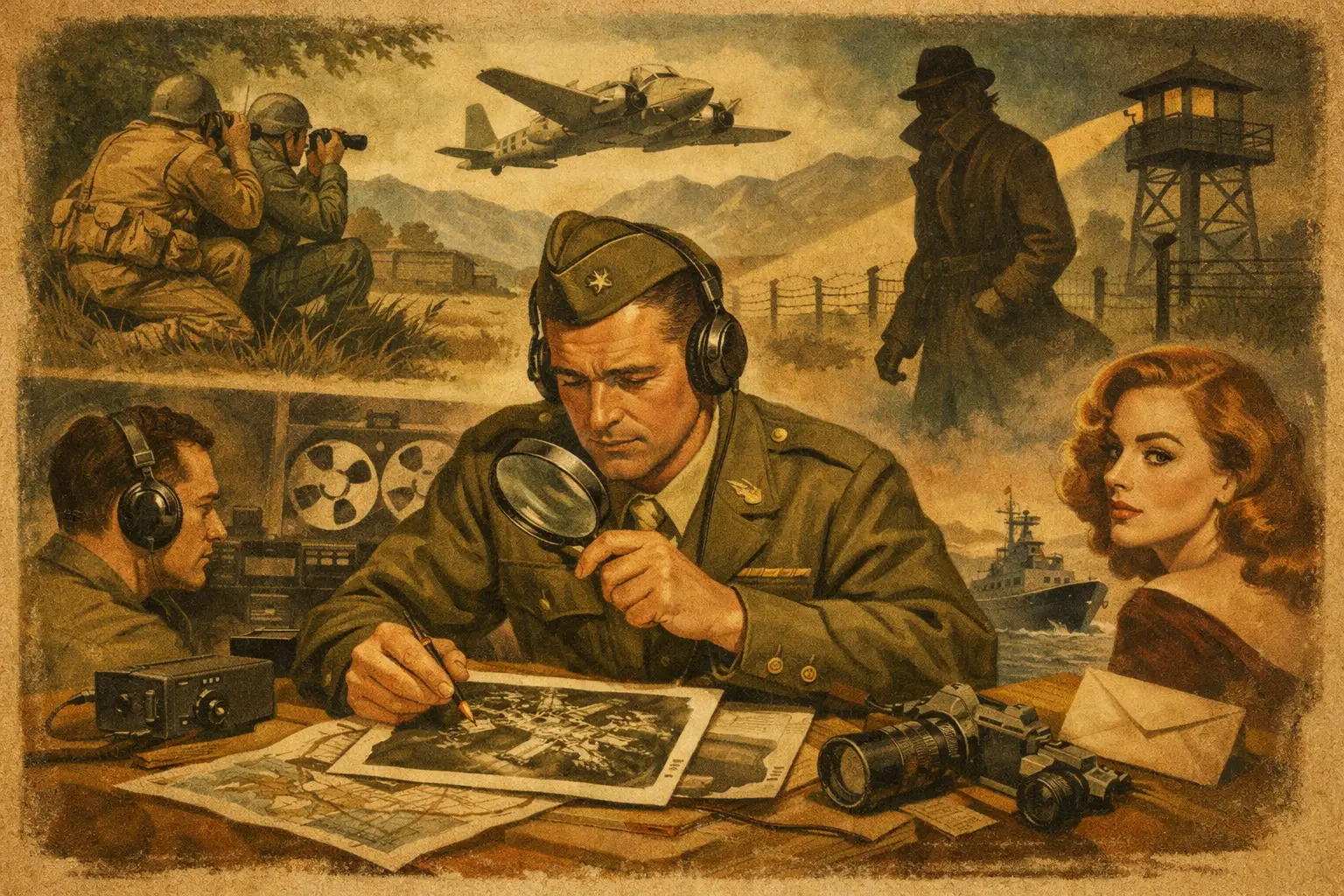
A battlefield is never limited to the ground its soldiers occupy. Before armies move, someone has judged the terrain, measured an opponent’s appetite for risk, tested a report for weakness, and decided which truth must remain concealed. The finest novels about military intelligence understand this prior struggle. They treat information not as background machinery but as a force that can redirect a campaign, preserve a state, or destroy the people entrusted with its secrets.
This is why the subject retains such force in fiction. Intelligence work places human judgment under conditions of radical uncertainty. A commander may possess maps, scouts, intercepted messages, and capable advisers, yet still act on a false picture. The agent who acquires valuable intelligence may also be compromised by the act of acquiring it. A warning delivered too late is not merely incomplete. It becomes part of the disaster it was meant to prevent.
For readers drawn to history, strategy, and leadership, these novels offer more than suspense. They dramatize a central fact of power: decisions are made before knowledge is complete, and the cost of misreading another mind can be immense.
What Novels About Military Intelligence Reveal
Military intelligence is often reduced to a familiar image: a coded message, a shadowed meeting, a daring infiltrator behind enemy lines. Those elements have their place, but the deeper subject is interpretation. Raw information has little value until someone determines what it means, what it omits, and whether an adversary intended it to be found.
That distinction gives the genre its moral weight. A spy thriller can move quickly from clue to clue. A serious intelligence novel slows the reader at the point of judgment. Who benefits if this report is believed? What does a commander do when two sources contradict each other? How much certainty is required before ordering an action that cannot be recalled?
The most memorable stories also refuse the fantasy that intelligence produces control. It can sharpen command, but it can also create the dangerous illusion that command has mastered events. War remains subject to weather, fear, ambition, fatigue, chance, and the stubborn independence of other human beings. Intelligence reduces uncertainty. It does not abolish it.
The Best Fiction Makes Information Personal
In John le Carre’s Tinker Tailor Soldier Spy, intelligence is an institution as much as an occupation. The investigation is compelling not because secrets are hidden, but because the hidden thing has altered loyalties, careers, marriages, and self-understanding. Le Carre’s great subject is the damage caused when a service built on suspicion must turn that suspicion inward. The novel is not military fiction in the conventional battlefield sense, yet it is indispensable to anyone interested in how intelligence organizations preserve authority and how they decay.
Robert Harris’s Enigma turns toward wartime cryptanalysis, where the problem is not simply breaking a code but deciding how to use the advantage without revealing its existence. The novel makes procedure dramatic: intercepted signals, patterns in naval movement, and the immense pressure placed on people whose calculations may determine whether ships live or vanish at sea. Its achievement lies in showing that an intelligence victory often requires restraint. To exploit every secret is to announce that one possesses it.
Ken Follett’s Eye of the Needle offers a more immediate contest between a German agent and the Allied deception surrounding the Normandy invasion. Its pace is sharper and more overtly suspenseful, but its strategic premise is sound: a single confirmed observation can endanger an operation built on carefully managed appearances. The story gives shape to a hard truth about deception. An elaborate falsehood does not need to persuade everyone. It needs to persuade the right observer at the right moment.
Tom Clancy’s The Hunt for Red October approaches military intelligence through naval command, technical knowledge, and competing readings of intention. The central question is not only where a Soviet submarine is located, but why its captain has acted as he has. That distinction matters. Facts without an understanding of motive can lead to escalation. Clancy’s novel is at its strongest when analysts and commanders must choose between the safest interpretation and the one that best explains the evidence.
These books differ in style and era, but they share a conviction that intelligence is a contest of disciplined perception. The dramatic stakes arise not merely from what characters know, but from what they dare to infer.
Intelligence Is Also a Question of Governance
The strongest military intelligence fiction reaches beyond the agent, the analyst, or the field commander. It asks what kind of state produces good judgment. Is dissent permitted when official assumptions harden into doctrine? Are reports valued for accuracy, or for their usefulness to powerful men? Can an institution distinguish inconvenient truth from disloyalty?
Such questions matter because intelligence failures are rarely caused by ignorance alone. They are often failures of organization and character. A warning may be dismissed because it disrupts a preferred plan. An official may soften an assessment to avoid conflict. A commander may demand certainty from a system that can offer only probability. Fiction can make these abstractions visible by giving them faces: the subordinate who hesitates, the ruler who refuses correction, the messenger whose credibility has been spent.
This is where historical fiction has particular power. It can place readers inside societies where the formal language of intelligence differs from the modern vocabulary of agencies, satellites, and signals analysis, while preserving the underlying strategic problem. Scouts, emissaries, merchants, defectors, prisoners, and rival ministers all become sources. Court ritual, rumor, logistics, and diplomacy become instruments of perception. The technology changes. The human problem does not.
Choosing a Novel for Strategic Depth
Readers seeking this subject should decide what kind of intelligence conflict they want to examine. A codebreaking novel emphasizes analysis, systems, and the tension between knowledge and disclosure. A field-agent story emphasizes disguise, access, and personal exposure. A command-centered novel examines how leaders act on incomplete reports. Historical fiction can reveal intelligence as an extension of governance, where a ruler’s ability to hear the truth determines the strength of the realm.
No one approach is inherently superior. The trade-off is one of emphasis. A fast-moving covert operation may sacrifice institutional complexity for momentum. A densely layered novel of bureaucracy and counterintelligence may require patience before its stakes become clear. Readers who want a study of strategy should look for books in which intelligence changes decisions, rather than merely supplying plot twists.
The most rewarding works also make room for restraint. Intelligence is often celebrated as an instrument for winning, but its higher purpose may be preventing a battle that need not occur, avoiding a provocation, or recognizing that a visible victory carries an unseen cost. This is a more difficult kind of drama because it concerns actions withheld. Yet it is closer to the reality of serious command.
A Story Where Knowledge Becomes Power
The lasting appeal of this fiction lies in its refusal to separate intellect from consequence. A mistaken judgment can cost an army. A carefully planted rumor can reshape a border. A leader’s vanity can make accurate intelligence useless. The great intelligence novel makes these forces felt before the first sword is drawn or the first shot is fired.
That tradition is central to The Shuai-jan, where strategic thought is not presented as a set of detached maxims but tested through the pressures of conflict, leadership, loyalty, and rule. The question is never simply who possesses information. It is who can govern themselves well enough to use it.
Choose the novels that leave you thinking not only about secrets, but about the discipline required to recognize the truth when it arrives in an inconvenient form.
Leave a Reply