
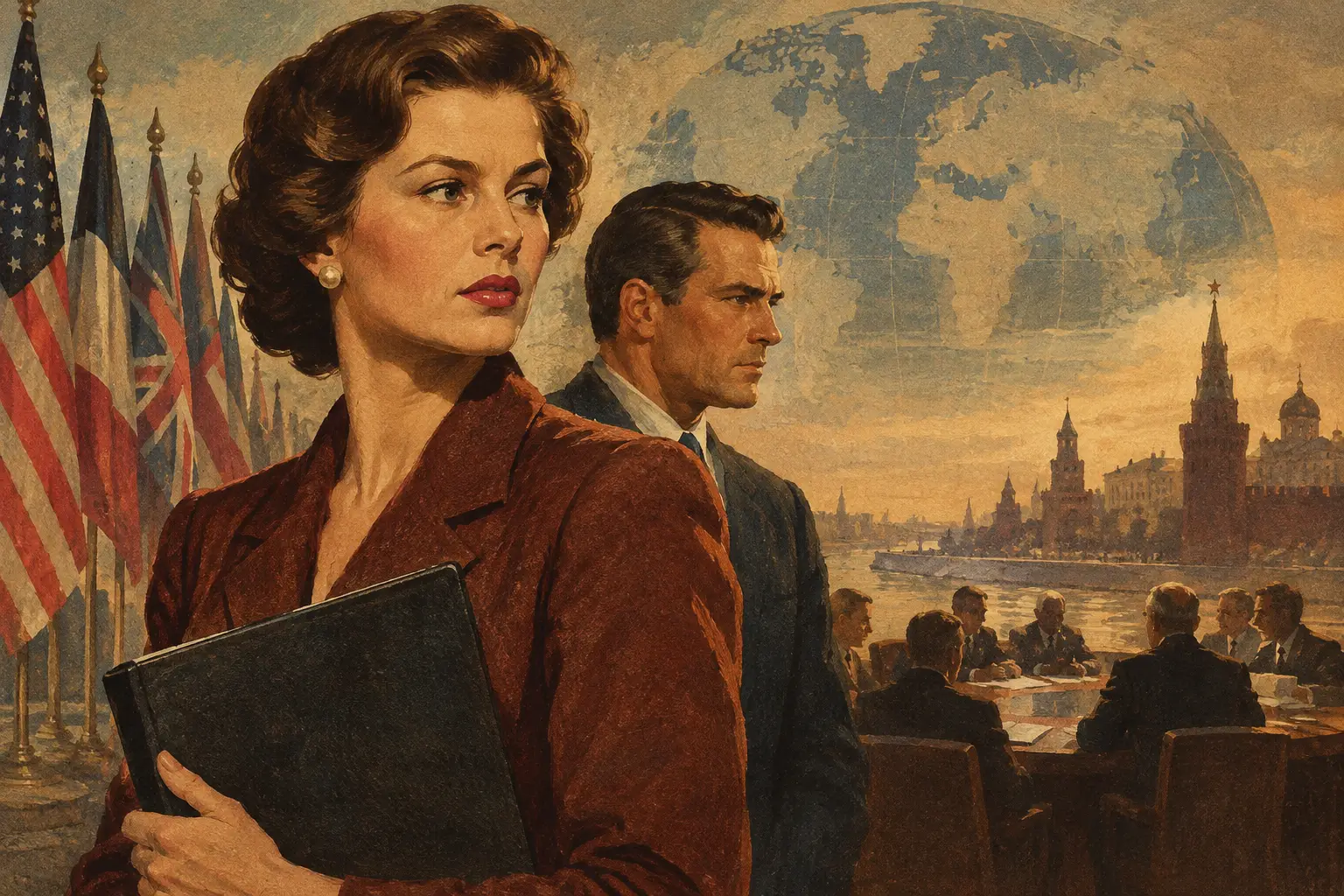
A diplomatic crisis begins long before the first shot. It begins in a private report, an intercepted message, a border incident whose meaning is unclear, or a ruler forced to decide whether an insult is theater or prelude. The best fiction about diplomatic crises understands that war is often shaped by men and women attempting to prevent it, exploit its approach, or control the story told about it.
These novels do more than place ambassadors and intelligence officers near important events. They examine the machinery of statecraft: misreading, leverage, secrecy, ideology, vanity, and the discipline required to act without complete knowledge. For readers drawn to strategy, the strongest works reveal a hard truth: diplomacy is not the opposite of conflict. It is conflict conducted under constraints.
What Makes Diplomatic-Crisis Fiction Endure
A compelling crisis novel does not depend solely on a ticking clock. Its pressure comes from competing perceptions. One government seeks deterrence; another sees provocation. A local commander acts from fear while distant leaders must decide whether to disavow him. An intelligence report is accurate, yet politically unusable.
The genre also rewards restraint. In lesser fiction, the decisive figure solves the crisis through a speech, a secret weapon, or a clean act of courage. The better novels recognize that outcomes are usually compromised. A catastrophe may be avoided while trust is destroyed. A treaty may preserve peace while planting the grievance that makes a later war inevitable.
12 Best Fiction About Diplomatic Crises
The Quiet American by Graham Greene
Greene’s Vietnam is a place where diplomacy, intelligence, journalism, and private desire have become impossible to separate. Thomas Fowler, a British correspondent, watches the rise of Alden Pyle, an idealistic American whose abstract faith in political reform produces consequences he cannot fully see.
The novel’s power lies in its refusal to treat innocence as harmless. Pyle is not a conventional villain, yet his certainty makes him dangerous. Greene exposes the cost of viewing a complicated country as a strategic diagram. For readers interested in intervention, influence, and the moral failures concealed within policy language, this remains essential.
The Ugly American by Eugene Burdick and William J. Lederer
This episodic novel is more polemical than Greene’s work, but its central question remains sharp: why do powerful nations repeatedly misunderstand the people whose allegiance they seek? Set in the fictional Southeast Asian country of Sarkhan, it contrasts officials insulated by embassy life with those willing to learn local languages, conditions, and interests.
Its portraits can be broad, and its Cold War assumptions deserve scrutiny. Still, the book endures because it treats cultural intelligence as a strategic necessity rather than a social grace. Its failures of diplomacy arise not from a lack of resources, but from arrogance and poor observation.
The Spy Who Came in from the Cold by John le Carré
No novel better captures the moral frost of Cold War maneuver. Alec Leamas, a British intelligence operative, is sent into a dangerous deception involving East German security services. What appears to be a mission of retaliation gradually reveals itself as something colder and more calculated.
Le Carré’s achievement is to show intelligence work as an extension of diplomatic conflict, where public peace coexists with covert cruelty. The novel offers no clean division between necessity and corruption. It asks whether a state can preserve its moral authority while treating human beings as expendable instruments.
The Day of the Jackal by Frederick Forsyth
Forsyth’s thriller concerns an assassination plot against Charles de Gaulle, but its deeper subject is the vulnerability of political order. France is still carrying the wounds of Algeria, and the planned murder threatens not merely a president but the credibility of a state attempting to emerge from colonial war.
The procedural precision is the attraction. Every passport, payment, border crossing, and security failure becomes part of a larger contest between a determined individual and a government under strain. The diplomatic dimension is indirect but decisive: domestic security cannot be separated from the international conflicts that create its enemies.
Fail-Safe by Eugene Burdick and Harvey Wheeler
A technical error sends American bombers toward Moscow, placing the United States and Soviet Union on the edge of nuclear war. The premise is stark, almost austere, and that austerity gives the novel its force. The crisis does not emerge from grand ambition alone. It emerges from systems designed to prevent error that nonetheless create a new form of it.
Fail-Safe is indispensable reading on command, escalation, and the terrifying limits of rational control. Its leaders must communicate across ideological hostility while time disappears. The novel’s bleakness is not melodrama. It is an argument that procedures, however carefully designed, cannot remove the human burden of judgment.
The Hunt for Red October by Tom Clancy
Clancy turns a Soviet submarine commander’s defection into a contest of interpretation. Is Marko Ramius preparing an attack, conducting an unauthorized exercise, or attempting a defection that could itself trigger war? The answer matters, but the process of determining it matters more.
The novel is often remembered for hardware and maritime suspense. Its greater strength is epistemic: each side acts with incomplete knowledge, and a mistaken assumption could unleash disaster. The American and Soviet leaders are not simple antagonists. They are custodians of forces they can only partly direct.
The Last Good German by Joseph Kanon
Set in occupied Berlin after World War II, Kanon’s novel follows an American journalist confronting the uneasy transition from wartime alliance to Cold War rivalry. The formal conflict has ended, but the struggle over scientists, information, and political legitimacy has already begun.
This is diplomatic-crisis fiction in a quieter register. Its stakes emerge through occupation policy and private bargains rather than emergency summits. Kanon is particularly attentive to the moral debris left behind when one strategic order collapses and another is built from its ruins.
The Sympathizer by Viet Thanh Nguyen
Nguyen’s narrator, a communist spy embedded among South Vietnamese exiles in the United States, lives within divided loyalties that no official communiqué can resolve. The novel is mordantly funny, deeply political, and unafraid of contradiction.
Its relevance to diplomatic crisis lies in its exposure of the stories nations tell about liberation, loyalty, and betrayal. Policy is never merely policy here. It is carried through memory, language, exile, and the pressure to choose a side when every side has committed violence. This is a demanding novel, but its intelligence is unusually penetrating.
The Ambassador by Morris West
Morris West places a papal diplomat in communist Eastern Europe, where religious authority, state power, and private conscience collide. The setting allows West to explore diplomacy without the conventional apparatus of superpower espionage. His envoy possesses limited formal power, yet must negotiate with actors for whom compromise can be both survival and betrayal.
The novel is especially interested in the burden of representation. An ambassador does not act only as an individual; he embodies an institution, a history, and a set of expectations that constrain every choice. That tension gives the book a grave, deliberate force.
The Tears of Autumn by Charles McCarry
McCarry’s Paul Christopher is sent into the shadowed terrain of postwar espionage, where the assassination of an American president becomes entangled with Vietnam, China, and the long memory of covert action. This is not a novel of official diplomacy so much as its concealed underside.
Its value is in showing how governments may create consequences they cannot later manage. Alliances, operations, and secret promises acquire momentum. The state begins to resemble a chess player who has forgotten which pieces were sacrificed and why.
The Foreign Student by Susan Choi
Choi’s novel follows Chang Ahn, a Korean student in 1950s America, as the Korean War transforms the meaning of his presence abroad. The crisis reaches him not as a classified briefing but as a pressure on identity, intimacy, and belonging.
This is a valuable corrective to crisis fiction centered exclusively on officials. International conflict is lived by those displaced by policy and by history. Choi’s restrained, psychologically acute approach reveals what strategic maps leave out: the individual consciousness caught between nations.
The Shuai-jan by Ralph Srouji
For readers seeking a historical novel in which strategy is not decoration but governing principle, The Shuai-jan approaches conflict through leadership, intelligence, and the disciplined management of perception. Its engagement with the strategic world associated with Sun Tzu gives particular weight to the problems that precede open battle: how authority is built, how information is tested, and when force becomes an admission of failed judgment.
Its concerns are therefore closely aligned with diplomatic-crisis fiction, even where the setting and form differ. Power is presented not as spectacle, but as a responsibility shaped by preparation and restraint.
Read These Novels for the Decisions Before War
The finest fiction about diplomatic crises does not promise that wisdom will always prevail. It shows why wisdom is difficult: information is partial, motives are obscured, institutions protect themselves, and even honorable people can mistake conviction for understanding.
That is precisely why these books remain worth reading. They restore consequence to the moment before the order is given, before the border is crossed, before the envoy returns with an answer that may be too late. Read them not for reassurance, but for a clearer sense of what disciplined judgment demands when power is most tempted by haste.
Leave a Reply