
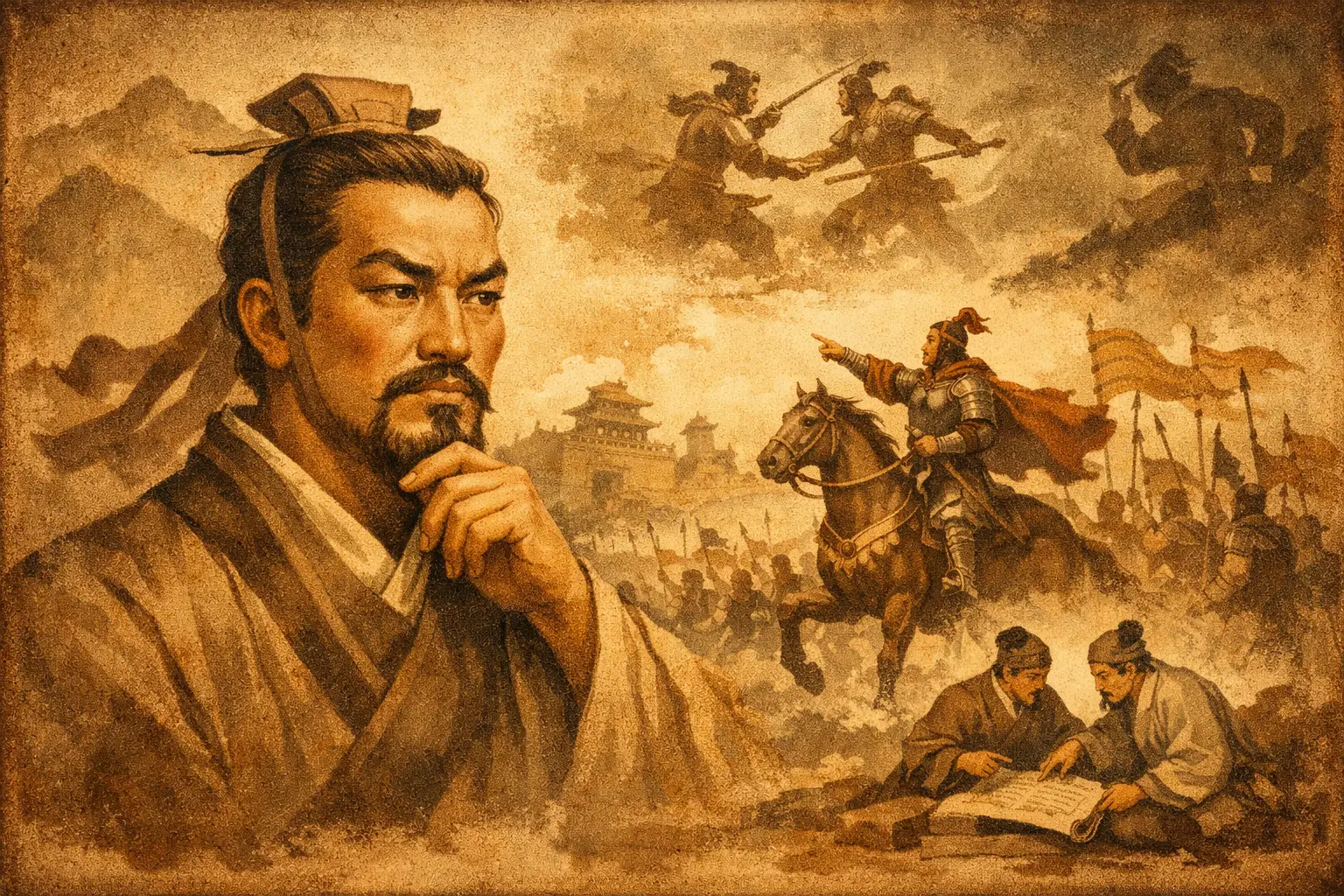
A fictionalized Sun Tzu story begins where quotation ends. It does not treat The Art of War as a cabinet of clever maxims, nor does it reduce strategy to a set of business slogans. It asks a more demanding question: what kind of person must one become to see conflict clearly before conflict has fully declared itself?
That question belongs to the world of fiction because strategy is never merely abstract. It is carried by frightened messengers, ambitious ministers, exhausted soldiers, rulers who mistake ceremony for authority, and commanders who must decide what can be sacrificed before the cost is visible. A principle may be concise on the page. In a human life, it acquires weather, consequence, and moral weight.
Why Strategy Needs a Human Face
Sun Tzu’s enduring force lies partly in compression. He writes of deception, terrain, intelligence, timing, discipline, and the danger of prolonged war with the economy of a thinker who understands that every unnecessary word may obscure a necessary distinction. Yet compression leaves a productive silence. It tells us what a commander must understand, but not always what it feels like to acquire that understanding under pressure.
Fiction enters that silence. It gives strategy a body and a cost.
Consider intelligence. In theoretical language, intelligence is the foundation of sound action. In narrative, it becomes a network of uncertain loyalties. A report may arrive late because a courier feared a border patrol. A source may speak truth for the wrong reason. A ruler may reject accurate information because accepting it would expose his own weakness. The problem is no longer whether intelligence matters. The problem is whether anyone possesses the discipline to recognize it when it contradicts desire.
This is why the strongest historical fiction does more than place familiar ideas inside period clothing. It tests those ideas against pride, grief, hunger, fear, and political necessity. Strategy becomes credible when it must survive human weakness.
The Fictionalized Sun Tzu Story Is Not a Biography
A fictionalized Sun Tzu story should not be mistaken for a simple reconstruction of the historical Sun Tzu. The surviving record is sparse, contested, and shaped by later tradition. That uncertainty is not an inconvenience to be hidden. It is an artistic condition that demands rigor.
The novelist’s task is not to manufacture certainty where history offers none. It is to build a convincing moral and political world around the questions associated with Sun Tzu’s thought. What does preparation look like in a court governed by vanity? How does a commander preserve order when a campaign begins to consume the very state it is meant to defend? When is restraint a form of strength, and when is it only hesitation wearing a noble mask?
The distinction matters. A novel that merely invents exploits for a legendary strategist can flatter the reader’s appetite for genius. A more serious work examines the systems that make strategic judgment possible or impossible: administration, supply, ritual, law, loyalty, communication, and the long memory of the governed.
War, in this view, is not the stage upon which a solitary hero proves himself. It is the failure point of an entire political order.
Conflict Is Decided Before the Battlefield
One of Sun Tzu’s most challenging propositions is that the highest form of victory makes battle unnecessary. It is often repeated because it sounds elegant. It becomes far less comfortable when rendered as fiction.
To avoid battle may require years of preparation that produce no public glory. It may mean strengthening granaries while rivals fund pageantry, cultivating sources while others demand immediate action, or accepting a temporary humiliation to prevent a permanent disaster. Such choices rarely satisfy an audience inside the story. Courtiers call them weakness. Rivals call them fear. Even allies may lose patience.
This is where narrative clarifies the difference between caution and strategic restraint. Caution avoids risk because it fears loss. Restraint accepts risk but refuses to spend lives, resources, and legitimacy merely to display resolve. The distinction can only be understood through consequences. A commander who delays action must live with the suffering that delay permits. A commander who attacks too soon must live with the dead.
The result is not a clean lesson. It is an examination of judgment.
Leadership Is an Act of Perception
In a strategic novel, leadership is not chiefly charisma. It is the ability to distinguish appearance from condition.
An army may look formidable while its supply lines deteriorate. A minister may speak of peace while positioning his family for civil conflict. A city may appear loyal while its people have already concluded that the state no longer protects them. Leaders fail when they govern the visible performance rather than the underlying reality.
That failure has contemporary resonance, but it need not be forced into modern language. The ancient world already understood the seductions of spectacle, the damage done by unexamined ambition, and the fragility of institutions built around a single will. Historical fiction earns its relevance not by preaching equivalence, but by showing enduring pressures at their source.
What Fiction Can Show That Commentary Cannot
Commentary explains a principle. Fiction places the reader inside the moment when a principle becomes difficult to follow.
A reader can agree that deception is useful until deception poisons a marriage, compromises an honorable subordinate, or creates a falsehood the state itself begins to believe. A reader can admire discipline until discipline becomes indistinguishable from cruelty. A reader can praise decisive leadership until decisiveness closes the door on counsel.
These tensions prevent strategic thought from becoming worship of control. Sun Tzu’s work is frequently invoked by people seeking advantage, yet its deeper argument concerns proportion. Force must serve a political end. Knowledge must precede action. Command must be ordered. Victory that destroys the conditions of future stability is not mastery. It is merely destruction with a banner.
A novel can hold these contradictions without flattening them into a lecture. It can allow an intelligent character to make a disastrous choice for reasons that remain understandable. It can show that an enemy is not irrational simply because he stands on the other side of a border. It can make the reader feel the terrible competence of an adversary and the dangerous appeal of a leader who believes necessity excuses everything.
That is not a retreat from strategy. It is strategy returned to its proper scale: human beings acting under conditions they only partly understand.
The Weight of Governance
The most compelling stories shaped by Sun Tzu’s ideas do not end at the command tent. They move outward, into the state.
A campaign depends on farmers who must leave fields untended, officials who must allocate scarce resources, families who absorb absence, and communities that learn whether their rulers regard them as citizens or material. The cost of war is therefore administrative before it is heroic. A ruler who cannot govern peace will not govern war for long.
This is one reason a historical novel centered on strategy can speak to readers interested in leadership beyond military history. It does not offer a portable formula for winning. It asks whether authority has earned the right to command, whether institutions can carry pressure without breaking, and whether leaders can resist confusing personal ambition with public necessity.
At its best, this is the territory a work such as The Shuai-jan by Ralph Srouji seeks to inhabit: not a decorative past, but a contested world in which intelligence, loyalty, and force shape one another.
Reading Strategy as Drama
Readers drawn to Sun Tzu often arrive with a respect for the text’s clarity. Fiction offers another form of clarity, one made through immersion rather than instruction. It lets a principle unfold slowly enough for doubt to enter. It asks the reader to inhabit competing perceptions before deciding whose judgment deserves trust.
That experience is particularly valuable because strategic language can create an illusion of distance. Terms such as advantage, position, and control sound impersonal until a character discovers that every advantage is paid for by someone, every position can collapse, and control is often more fragile than the powerful admit.
The best fictional treatment does not make Sun Tzu easier. It makes him harder to dismiss. It restores the pressure behind the aphorism and reveals the discipline required to act without vanity, prepare without panic, and use power without becoming captive to it.
Read such a story not as a search for ancient answers to modern problems, but as training in attention. Notice who sees clearly, who confuses confidence with knowledge, and who understands that the first victory may be the decision not to waste a life for the sake of being seen as strong.
Leave a Reply