
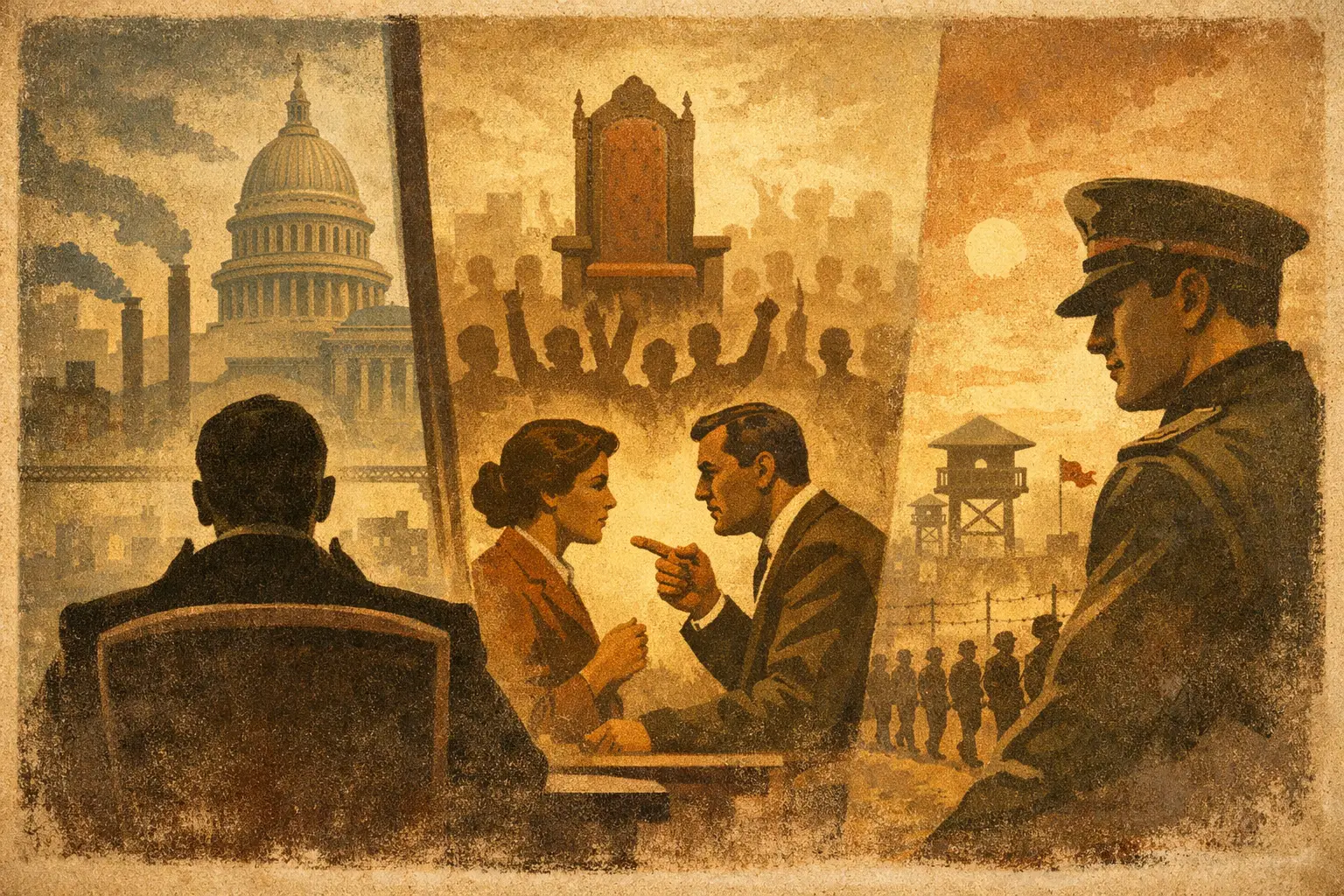
A throne, a council chamber, and a battlefield are only the visible surfaces of rule. The decisive struggle often occurs elsewhere: in the report a minister chooses to suppress, the grain reserve a magistrate fails to protect, the commander who mistakes obedience for loyalty. Fiction exploring power and governance gives these hidden pressures a human form. It shows that authority is never merely possessed. It must be interpreted, enforced, justified, and, at critical moments, restrained.
For readers drawn to history, strategy, and political thought, this is where serious fiction earns its force. A treaty may be recorded in a chronicle; a novel can reveal the fear behind its signature. A campaign may be described as a victory; a story can ask what intelligence was ignored, which faction benefited, and what ruin was quietly prepared by triumph. Governance becomes more than an arrangement of offices. It becomes a test of judgment under conditions where every decision alters the ground beneath those who must live with it.
Why Power Is More Than Command
Power is frequently reduced to command: one person gives an order, another carries it out. This model is simple, dramatic, and incomplete. Durable power depends on institutions, customs, information, material resources, and the confidence of people who may comply for reasons very different from loyalty.
A ruler can possess armies and still govern poorly. A general can win a battle and weaken the state he claims to serve. A minister can speak the language of stability while advancing a private rival. These are not peripheral complications. They are the substance of political life.
Fiction is particularly suited to this territory because it can hold competing perspectives without prematurely resolving them. The sovereign sees necessity. The advisor sees danger. The soldier sees exhaustion. The farmer sees a levy that turns an imperial ambition into an empty granary. Each perspective carries partial knowledge, and power is shaped by the gap between what leaders believe and what their subjects endure.
This is why the most enduring political fiction does not merely identify a villain and a hero. It examines systems that reward flattery, punish candor, and turn temporary expedients into permanent habits. It understands that cruelty may be blunt, but failure is often administrative: a delayed message, a compromised scout, an official promoted beyond his competence, a court too insulated to recognize the cost of its own decisions.
Fiction Exploring Power and Governance at Human Scale
Abstract political theory can explain the structure of a state. Fiction places a human being inside that structure at the moment a principle becomes consequential. The question is no longer whether surveillance improves security in the abstract. It is whether a commander should trust intelligence gained through betrayal, knowing that its use may preserve an army while corrupting the order it defends.
That tension matters because governance is not simply a contest between ideals and expediency. It is a discipline of choosing among imperfect options. The responsible leader does not ask only, “Can this be done?” He asks what it will cost, who will bear that cost, and whether the apparent advantage will weaken the larger purpose.
Historical fiction has a particular advantage here. Distance grants clarity. Readers can study a vanished court, a fractured kingdom, or an army on campaign without the reflexes that attend contemporary political arguments. Yet the distance does not make the subject remote. It reveals recurring patterns: intelligence distorted to satisfy authority, rivals elevated in the name of unity, public virtue used to conceal private ambition, and force employed where preparation might have prevented conflict.
A novel can also restore moral weight to words that have become thin through repetition. Terms such as order, security, loyalty, and peace sound admirable until a character must decide whose freedom is narrowed to preserve them. Then governance appears in its proper complexity. Order may protect ordinary life, but it can become an excuse for silence. Loyalty can sustain a people, but it can also demand allegiance to an unworthy cause. Peace may be a genuine achievement, or simply the stillness imposed by fear.
The Strategic Value of Limits
Weak stories often treat power as a form of personal enlargement. The powerful character acts, commands, acquires, and conquers. Serious fiction recognizes a harder truth: the measure of power is frequently found in limitation.
A ruler who knows when not to punish may preserve more authority than one who makes an example of every dissenter. A commander who refuses a glorious but costly engagement may protect the state more effectively than the one who seeks renown. An advisor who withholds judgment until evidence is sufficient may be more valuable than the eloquent counselor with an answer for every uncertainty.
Restraint is not passivity. It is control directed inward before it is exercised outward. It requires a leader to distinguish between a personal insult and a public threat, between a temporary loss and a strategic defeat, between information that is useful and information that is true.
This is one reason narratives of governance are often more compelling when they resist easy victory. Success achieved through excess may contain the seed of later collapse. A defeated faction may remain quiet without becoming reconciled. A city secured by fear may appear stable until pressure exposes the resentment beneath its obedience. Fiction gives consequence time to unfold, which is precisely what rhetoric and propaganda attempt to deny.
Intelligence, Perception, and the Problem of Trust
No government rules by force alone. It rules through information, and information is always vulnerable to distortion. Reports pass through interested hands. Messengers fear punishment. Spies sell fragments rather than certainty. Courtiers learn which facts please the ruler and which facts end careers.
The political problem is therefore not merely gathering intelligence. It is creating conditions in which unwelcome truth can reach the person responsible for acting on it. A leader who demands constant affirmation may believe he is strengthening discipline while he is actually blinding himself.
Fiction makes this danger immediate. Readers observe the private calculation behind public speech. They can see a subordinate alter a report, an official delay a warning, or a trusted ally conceal a divided allegiance. The reader is granted a strategic view that few characters possess, and that contrast creates both tension and instruction.
Yet the lesson is not that trust is foolish. No state, army, or household can function under universal suspicion. The deeper lesson is that trust must be joined to verification, and confidence to humility. Leaders need capable agents, but they also need structures that prevent any one agent from becoming the sole source of reality.
In Ralph Srouji’s The Shuai-jan, strategic thought is given narrative pressure rather than presented as a set of detached maxims. The concerns of intelligence, preparation, authority, and conflict matter because characters must act before outcomes are known. That is where strategy becomes more than doctrine: it becomes a burden carried by people whose choices shape lives beyond their own.
What Political Fiction Asks of the Reader
Fiction about governance does not ask readers to admire power from a safe distance. At its best, it asks them to judge it. Was the decision necessary? Was the evidence sufficient? Did the leader protect the state, or merely protect his position? Did victory create stability, or postpone a deeper reckoning?
These questions do not yield a single political doctrine. A centralized authority may be necessary during crisis and destructive when it becomes permanent. Openness may improve legitimacy while slowing urgent action. Mercy may strengthen a regime in one circumstance and invite further disorder in another. Context matters, which is why simplistic lessons fail under pressure.
The value of the novel lies in its refusal to make those pressures theoretical. It lets readers feel the cost of delay and the cost of haste. It reveals how noble language can conceal self-interest, while also admitting that imperfect institutions may still protect people from worse alternatives. Such fiction neither worships authority nor assumes its absence is freedom. It studies the difficult work of ordering collective life without forgetting the individual lives caught within that order.
The next time a fictional ruler issues a command, look past the command itself. Ask what intelligence made it possible, what institution will carry it out, what fear sustains it, and what consequences will remain after the banners have been lowered. That is where power becomes legible – and where governance begins.
Leave a Reply