
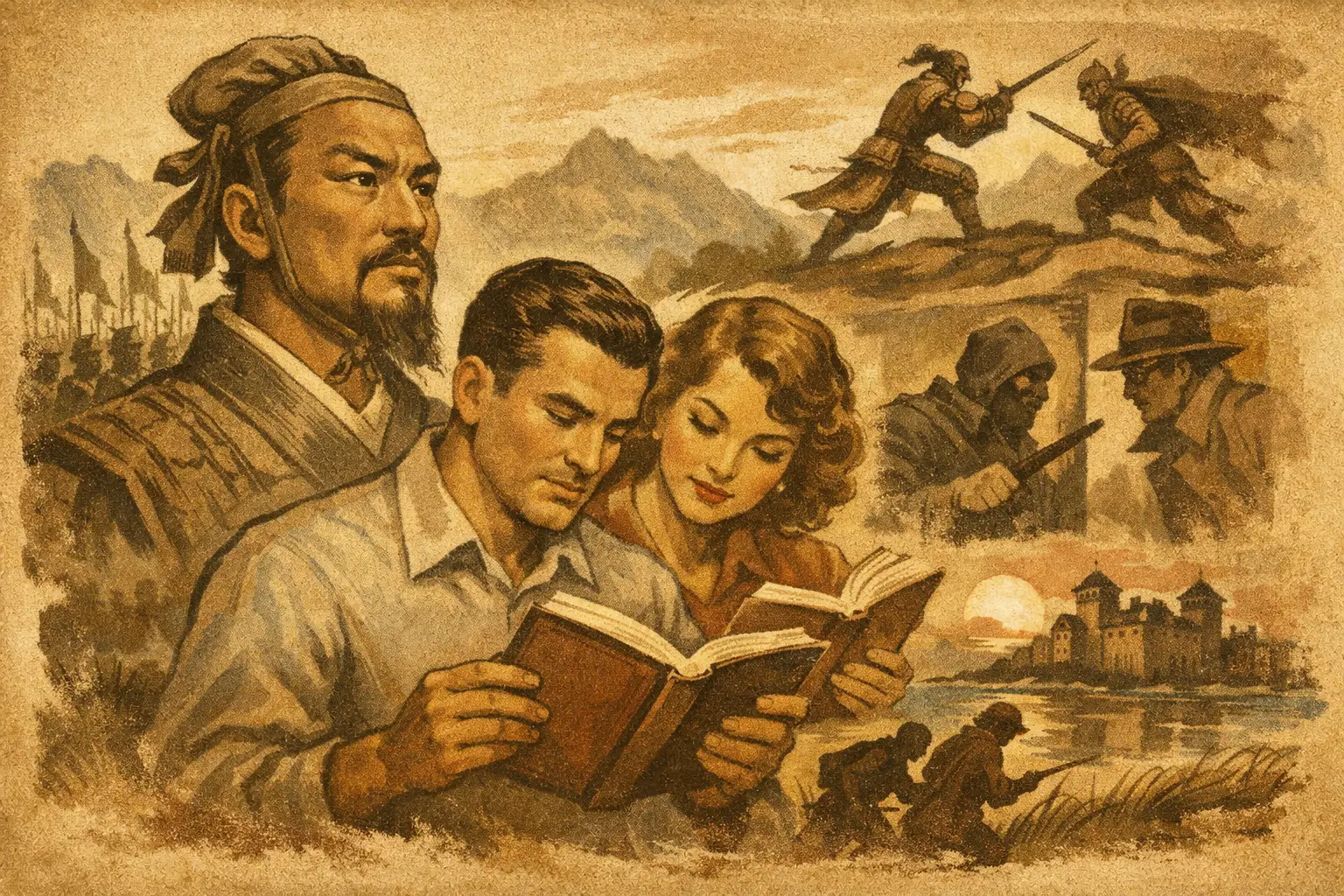
A strategist’s most consequential act is often invisible. It happens before the army advances, before an ally is named, before a ruler understands that the ground beneath his authority has shifted. That is why readers who enjoy Sun Tzu often seek more than military action in fiction. They seek the pressure behind action: the calculation, the withheld word, the intelligence report whose meaning is understood by only one person in the room.
The Art of War endures because it refuses to treat conflict as a spectacle. Its concern is not merely victory, but the conditions that make victory possible. It asks what can be known, what can be controlled, what must be concealed, and what price follows from a leader’s misjudgment. A work of historical fiction worthy of that inheritance does not turn those questions into slogans. It gives them bodies, loyalties, fears, and consequences.
Why Readers Who Enjoy Sun Tzu Turn to Fiction
Many readers arrive at Sun Tzu through business, leadership, military history, or personal discipline. Yet the compact brilliance of the text can create a further hunger. Maxims clarify principles, but they do not fully show what it costs to live by them. Fiction can.
A commander may know that the finest victory is won without battle. But what does that restraint look like when soldiers demand action, a rival court mistakes patience for weakness, and a threatened province begins to doubt its protector? A ruler may understand the value of intelligence. But how does that understanding alter the fate of an informant, the burden of a minister, or the conscience of the person asked to deceive a friend?
These are not decorative additions to strategic thought. They are its human reality. Strategy is never simply an arrangement of forces. It is an arrangement of people, each possessing incomplete knowledge and competing motives. Historical fiction gives this uncertainty a shape that theory alone cannot provide.
The best strategic fiction therefore does not pause its story to teach a lesson. It lets the lesson emerge from decision. A character acts too quickly and exposes a weakness. Another delays, gathers information, and discovers that delay itself has become dangerous. The reader sees that foresight is not clairvoyance, and control is never absolute.
Strategy Is More Than Warfare
Sun Tzu is often reduced to the language of combat, as though his relevance begins and ends with armies. Readers who return to the text usually recognize something broader. Its preoccupations include governance, perception, morale, terrain, timing, supply, deception, and the disciplined use of force. These are the mechanics of power wherever power is contested.
Historical fiction is particularly suited to this territory because the past makes systems visible. A court is not an abstraction when a succession crisis fractures its factions. Logistics are not a footnote when hunger weakens a garrison before an enemy arrives. Diplomacy is not a ceremonial exchange when one marriage, one hostage, or one insult can reorder a border.
For this audience, an absorbing novel should understand that a battle is often decided long before its first charge. It should attend to the patient work that precedes conflict: the cultivation of alliances, the measurement of a rival’s ambition, the reading of a landscape, the management of rumor. In such a narrative, action matters precisely because preparation has made its stakes intelligible.
This does not require every page to concern generals or councils. The effects of strategy travel downward. A farmer sees an army as requisitioned grain and an empty road. A courier knows power through sealed messages and guarded silences. A family at the edge of a kingdom understands a sovereign’s failure before the capital acknowledges it. The broadest political decisions become most vivid when they reach private lives.
The Appeal of Intelligence Under Pressure
Readers drawn to Sun Tzu tend to distrust simple heroism. Courage has its place, but courage without judgment can become vanity. The compelling figure is not always the person who strikes first. It may be the observer who notices a contradiction, the adviser who resists the ruler’s vanity, or the leader who accepts a smaller immediate gain to preserve a greater future position.
That preference changes what makes fiction satisfying. Plot alone is not enough. A reader wants to understand why a decision was made, what information shaped it, and which assumptions proved false. The pleasure lies partly in anticipation: noticing the imbalance in a negotiation, the concealed fracture in an alliance, the implication of a map or an overheard remark before the characters can act upon it.
But intelligence must not become omniscience. A flawless strategist quickly becomes inert, because certainty eliminates risk. The more persuasive story allows even disciplined minds to meet limits. Reports are incomplete. Subordinates distort the truth. Weather, illness, pride, and chance interfere with the best-laid design. A leader’s greatness may rest not in never being surprised, but in recovering command after surprise arrives.
That is where strategic fiction acquires moral force. It recognizes that superior knowledge can protect lives, but it can also be used to manipulate them. Deception may prevent a battle or betray a trust. Restraint may be wisdom or cowardice, depending on the moment. The reader is not asked to admire power automatically. The reader is asked to examine how power is exercised.
History Gives Consequence Its Weight
There is a reason strategy becomes more compelling when placed in a historical world. Modern readers may recognize familiar patterns of competition and influence, but distance strips away the comforting illusion that our present arrangements are permanent. Kingdoms rise through organization and fail through complacency. Institutions depend on individuals, yet individuals are constrained by institutions they did not create.
A carefully rendered past also resists the temptation to treat strategic principles as universally simple. Terrain is physical, but it is also cultural. A decision that succeeds in one polity may fail in another because legitimacy, custom, religion, and kinship alter what people will endure. The same display of strength can secure obedience in one moment and provoke rebellion in the next.
For readers interested in leadership, this is an essential corrective. Leadership is not the art of imposing one’s will upon a passive world. It is the art of recognizing the forces already in motion, deciding which can be redirected, and understanding which cannot. The greatest error is often not weakness, but misreading the field.
Historical fiction can make that misreading intimate. A ruler who sees only treachery may destroy loyal counsel. A commander who believes his troops invincible may exhaust them. A reformer who confuses urgency with readiness may turn a necessary change into a civil fracture. The consequences are not theoretical. They are carried in grief, exile, ruined cities, and the altered lives of those who had no seat at the council table.
What This Reader Wants From a Novel
The reader who values Sun Tzu’s thought is not necessarily looking for a novel that agrees with every principle in The Art of War. In fact, a mere dramatization of doctrine would be too narrow. What matters is a narrative serious enough to test strategic ideas against human complication.
Such a novel needs characters who can think, but who are not reducible to their plans. It needs conflict that proceeds through intelligence as well as violence. It needs a world in which command carries responsibility, where victory may involve sacrifice, and where restraint has a cost that cannot be calculated in advance.
It should also honor the reader’s capacity for inference. Not every motive needs to be announced. Not every maneuver needs to be translated into a lesson. When a narrative trusts silence, implication, and delayed revelation, it resembles strategic thought itself. Meaning is gathered from patterns. The decisive fact may be present long before it is recognized.
This is the territory in which The Shuai-jan by Ralph Srouji finds its purpose: not as an instructional recasting of Sun Tzu, but as a historical narrative in which strategy enters the lives of those required to wield it, endure it, or resist it.
A reader may close such a book with no desire to command armies. Yet the deeper questions remain. What did the leader see that others missed? Which victory was purchased too dearly? When was force necessary, and when did it merely reveal a failure of imagination? Fiction cannot settle those questions. It can place them where they belong: in the difficult space between power and judgment.
Leave a Reply