
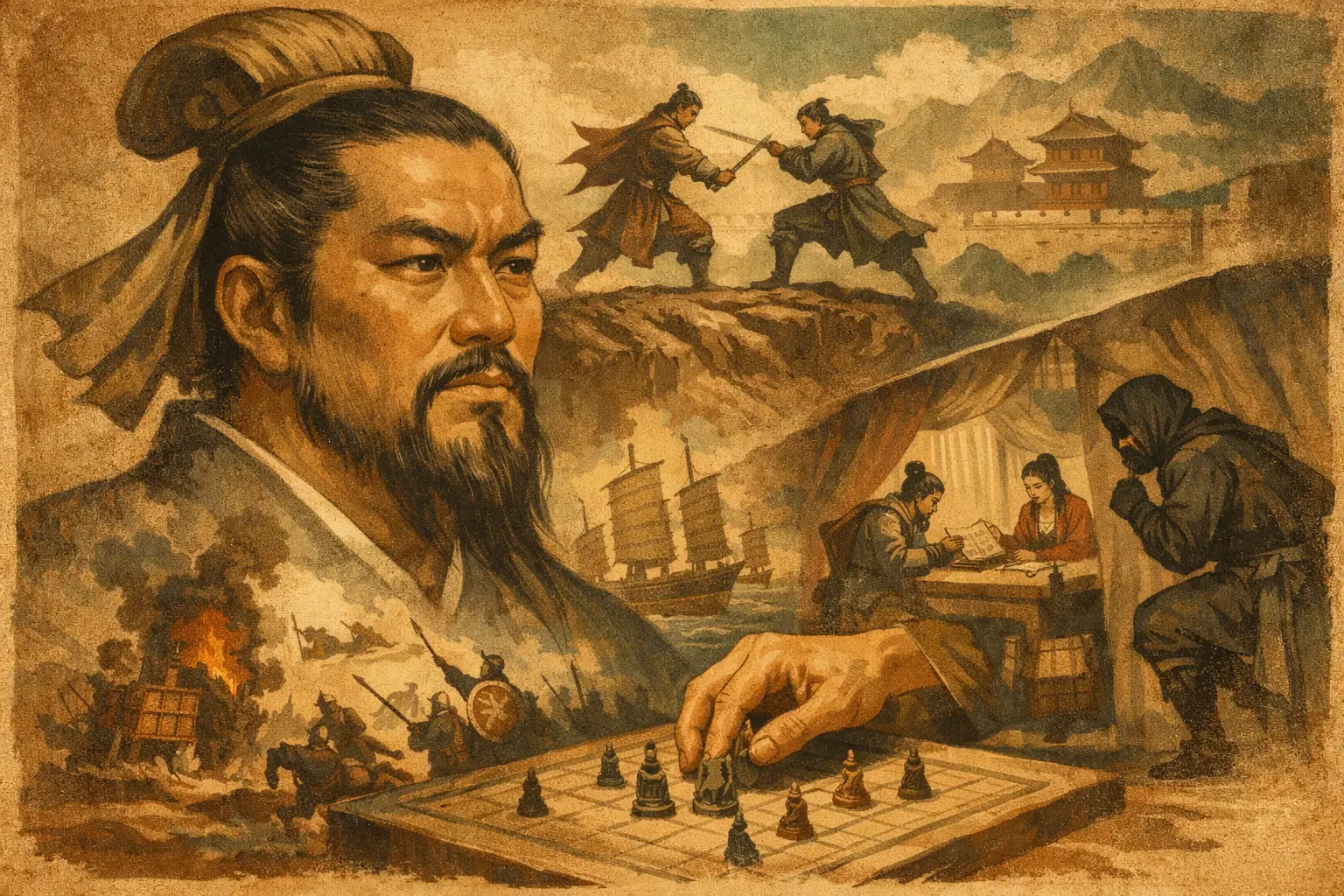
A Sun Tzu fiction adaptation faces a problem that a conventional historical novel does not: its source is already compressed to the point of severity. The Art of War offers judgments, distinctions, and imperatives. It does not supply the private fear behind an order, the exhausted messenger carrying intelligence through rain, or the governor who discovers too late that a victory has weakened the state he was meant to protect. Fiction must supply that human pressure without diluting the thought.
That is the real opportunity. Strategy becomes memorable when it enters the realm of consequence. A principle concerning deception is no longer an aphorism when a commander must mislead an enemy, an ally, and perhaps his own troops. A lesson in preparation gains weight when preparation demands sacrifice before danger is visible. The reader does not merely encounter an idea. The reader watches people live inside its cost.
Why Sun Tzu Resists Easy Adaptation
Sun Tzu is often treated as a dispenser of quotations. His observations are carried into boardrooms, athletic locker rooms, political campaigns, and social media captions, usually stripped of the conditions that give them force. Yet The Art of War is not a collection of slogans about domination. It is a discipline of judgment formed by uncertainty, limited resources, political responsibility, and the brutal fact that even a justified war can damage the society that wages it.
A fiction adaptation that mistakes this tradition for simple conquest will become a familiar tale of tactical brilliance. Its central figure will outthink opponents, win battles, and stand vindicated by results. That approach is efficient, but shallow. Sun Tzu’s strategic world is more demanding. The finest victory is not necessarily the loudest one. The best commander is not merely brave. He understands timing, terrain, morale, intelligence, supply, perception, and the limits of force.
This is why adaptation requires restraint. The novel must allow strategy to remain morally and politically complicated. A decision may be tactically sound yet corrosive to trust. A ruler may seek glory where a general sees only unnecessary expenditure. Intelligence may prevent a battle, but the methods used to obtain it can alter the character of those who rely on it.
A Sun Tzu Fiction Adaptation Needs Human Stakes
Abstract doctrine cannot carry a novel by itself. A reader turns pages because decisions affect lives, loyalties, inheritances, and identities. The task is not to turn every maxim into dialogue. It is to build a world in which strategic thinking determines who is heard, who is protected, and who is sacrificed.
Consider the difference between a general who says that knowing the enemy is essential and a general forced to trust a spy whose report condemns an entire border district. In the first case, the principle remains external. In the second, intelligence becomes a burden. The commander must assess not only what is known, but how knowledge was acquired, what it may conceal, and who will bear the penalty if it is false.
The same applies to leadership. In fiction, command is not an abstraction exercised from a hilltop. It is a relationship with soldiers who interpret every pause, every rationing decision, and every unexplained change of route. Authority depends on perception. Discipline can preserve an army, but discipline without legitimacy can turn obedience into brittle resentment. A serious adaptation gives such tensions room to develop.
This is where historical fiction can accomplish what commentary cannot. Commentary may explain the strategic value of morale. Narrative can show morale collapsing in a camp when promises are broken, then show the long work required to restore it. The concept becomes inseparable from memory.
The Drama of Preparation and Restraint
Popular war stories tend to reward action. They build toward the charge, the siege, the duel, the decisive maneuver. Sun Tzu places unusual pressure on what happens before those moments: reconnaissance, preparation, concealment, diplomacy, logistics, and the refusal to commit strength where strength cannot produce a durable result.
That apparent quiet is not a weakness in fiction. It is a source of suspense. A ruler’s impatience can threaten months of careful positioning. A small error in terrain assessment can make a planned retreat impossible. A negotiator’s hesitation may reveal that the enemy is more divided than scouts believed. When readers understand what is at stake in these seemingly minor signals, preparation becomes dramatic in its own right.
Restraint is harder still to dramatize because it can look, from a distance, like inaction. But restraint has a narrative cost. A commander who refuses battle may be accused of cowardice. A minister who counsels delay may lose political standing. A leader who spares a defeated rival may invite future danger. The choice not to strike should feel as consequential as the choice to attack.
The strongest adaptations therefore resist the temptation to make every strategic decision immediately legible. Characters act with incomplete information. Their reasons may be concealed from subordinates and even from the reader for a time. This creates tension without reducing strategy to a puzzle box. The eventual revelation matters because it exposes the discipline, or the fatal blindness, behind the decision.
Intelligence Is More Than Espionage
Readers often associate Sun Tzu with spies, and rightly so. Yet intelligence in this tradition is not confined to clandestine agents. It is the capacity to see conditions accurately before acting. It includes knowledge of an adversary, but also knowledge of one’s own capabilities, political constraints, emotional vulnerabilities, and material limits.
A novel can render this broad intelligence through contrast. One character sees an enemy army and counts banners. Another notices empty villages, delayed grain shipments, and the nervous behavior of local officials. The first receives information. The second interprets it. That difference can decide a campaign.
Still, intelligence carries ethical and personal consequences. Spies are often asked to inhabit false identities, manipulate affection, and report on people who have shown them kindness. Their work may preserve thousands of lives, but it rarely leaves them untouched. An adaptation that treats espionage as glamorous spectacle misses its deeper gravity: intelligence is power purchased through proximity to betrayal.
In The Shuai-jan, this landscape of calculation can be approached not as a manual transposed into costume, but as a living contest between men and women whose decisions shape armies, courts, and private loyalties. The strategic question is never merely whether a plan succeeds. It is what the plan asks its architects to become.
Governance Is the Hidden Battlefield
War does not begin at the border. It begins in the condition of the state: whether people trust authority, whether officials speak honestly, whether stores are protected, whether ambition outruns capacity. Sun Tzu’s thought cannot be fully adapted without this larger political frame.
A commander may win a field engagement and still serve a failing government. A sovereign may demand conquest to secure prestige while neglecting famine, corruption, or succession. In such conditions, military competence becomes tragically limited. The general understands the cost of war, but cannot always prevent those above him from treating war as theater.
This is fertile ground for fiction because it prevents strategic brilliance from becoming a fantasy of total control. No leader commands every variable. Counsel can be ignored. Reports can be altered. Allies can pursue separate interests. A state may possess a formidable army and still lack the internal coherence needed to use it wisely.
The result is a more truthful form of tension. Victory is never simply possession of the battlefield. It is the preservation of political order after the battlefield has fallen quiet.
What Readers Should Demand From the Form
A worthwhile adaptation should not offer Sun Tzu as an ornament, a name placed above a generic campaign story. It should make readers feel the pressure of his central concerns: the danger of acting from pride, the necessity of knowing conditions, the value of economy, and the disciplined preference for outcomes that do not squander human strength.
It should also preserve uncertainty. Strategy is not prophecy. Even excellent judgment can be defeated by weather, chance, divided loyalty, or an opponent who understands the same principles. That is not a flaw in the strategic tradition. It is the reason its emphasis on observation, flexibility, and self-command remains so severe.
For readers drawn to history, leadership, and the architecture of power, the enduring value of this form lies in its demand for attention. Read the battle, certainly, but watch the stores, the silences in council, the messenger who arrives late, and the commander who chooses not to pursue. Those are often the places where a nation’s future has already been decided.
Leave a Reply