
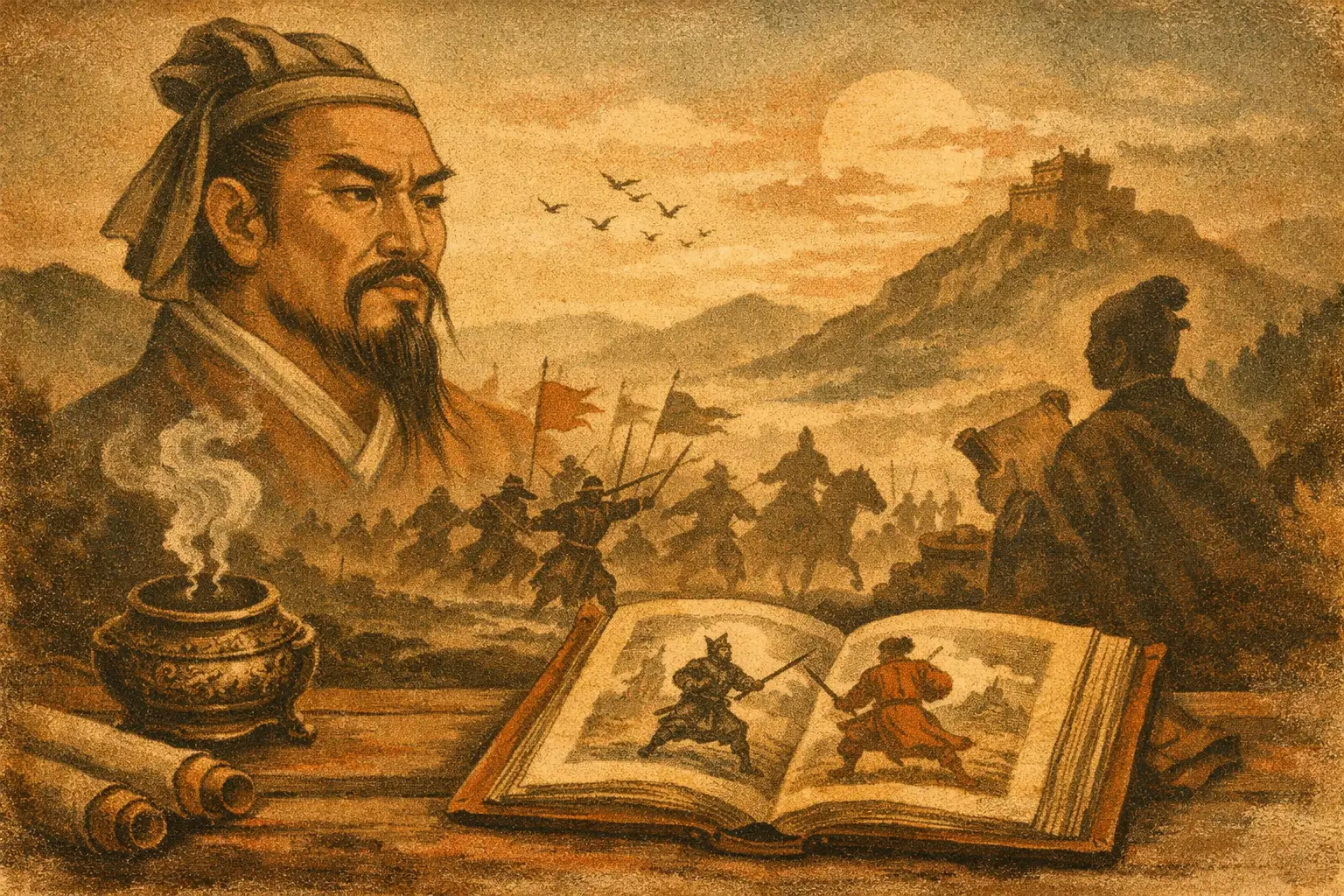
Sun Tzu is often quoted as if he were a supplier of portable maxims: win without fighting, know the enemy, appear weak when strong. A fictionalized Sun Tzu book asks a more demanding question. What does it cost a ruler, commander, spy, or family to live by such principles when the information is incomplete, loyalties shift, and each decision places real lives at risk?
That question changes the nature of the material. The Art of War is concise by design. It distills conflict into principles of calculation, intelligence, terrain, morale, timing, and control. Fiction gives those principles bodies, voices, consequences, and resistance. It makes strategy less like a collection of quotations and more like a discipline practiced under pressure.
For readers drawn to history, leadership, and the mechanics of power, this is not a minor distinction. It is the difference between admiring an idea and understanding the human conditions that make the idea difficult to apply.
Why Fiction Belongs Beside The Art of War
A strategic text can tell us that the finest victory is achieved before battle begins. A novel can show the years of preparation required for that victory: the patient cultivation of informants, the suppression of vanity, the negotiations that preserve an alliance, and the quiet compromises that leave a leader uncertain whether he has saved his state or merely delayed its ruin.
This is where fiction has a distinctive intellectual force. It does not simplify strategy into a lesson. It places competing lessons in collision. A commander may possess excellent intelligence but lack the political authority to act on it. A ruler may understand the necessity of restraint yet fear appearing indecisive. An advisor may see the field clearly while remaining trapped by rank, custom, or personal obligation.
Such conflicts are central to Sun Tzu’s world. War, in this tradition, is never merely the clash of armed bodies. It is an extension of governance, perception, logistics, character, and will. The battlefield matters, but so do the court, the council chamber, the road, the granary, and the private conversation where a confidence is gained or betrayed.
A serious historical novel can therefore do more than dramatize ancient combat. It can reveal why disciplined thought is rare when events accelerate and why clear judgment is often opposed by fear, pride, and appetite.
What a Fictionalized Sun Tzu Book Makes Visible
The most compelling strategic fiction does not turn Sun Tzu into an infallible sage who enters every scene with the correct answer. That approach produces reverence, not drama. A living interpretation must permit uncertainty. It must show that even sound principles can fail when applied without judgment.
Consider intelligence. Readers may know that Sun Tzu places extraordinary value on foreknowledge. Yet fiction can expose the fragility of intelligence itself. A report can be accurate and still arrive too late. A source can tell the truth for reasons that remain concealed. A leader can receive the correct information and distort it because it threatens a preferred plan.
The same is true of deception. Deception is often treated as the most glamorous part of strategy, but its deeper significance is psychological. To mislead an opponent, one must first understand what that opponent expects, fears, and desires. This requires observation, patience, and an ability to see beyond one’s own assumptions. In a novel, deception becomes morally and emotionally charged. It can protect a city from devastation. It can also corrode trust within the very force it is meant to preserve.
Leadership becomes clearer under the same scrutiny. A commander is not defined only by courage in the moment of danger. He is defined by the order he establishes before danger arrives. Does he reward useful truth? Can subordinates speak without fearing humiliation? Does he conserve strength rather than spend it to satisfy his own image? Can he distinguish a calculated retreat from a collapse of nerve?
These are not antique concerns. They remain recognizable in institutions of every kind. But historical fiction preserves their severity by returning them to a setting where failure is not abstract. A mistaken calculation may cost a province, a dynasty, or a generation.
Strategy Is a Study of Restraint
Popular readings of The Art of War often favor aggression. The language of conquest is easy to borrow and easy to admire. Yet one of Sun Tzu’s most enduring insights is that force is expensive, uncertain, and frequently less useful than the appearance of force.
A novel can restore the weight of that insight. It can portray restraint not as passivity, but as an act of control. The leader who refuses a glorious but ruinous battle may be judged a coward by those who cannot see the larger field. The agent who withholds a revelation may preserve an advantage that would otherwise vanish. The ruler who accepts an imperfect settlement may avoid a conflict that would consume the state.
None of these choices are clean. Restraint can become hesitation. Patience can become paralysis. A strategic novel earns its authority when it acknowledges this boundary. Principle is not a substitute for perception. The right action depends on timing, position, resources, and the nature of the people involved.
The Historical Novel as a Theater of Decision
Historical fiction has an obligation beyond atmosphere. Names, weapons, courts, and campaigns may establish a period, but they do not by themselves create historical meaning. The deeper task is to render the moral and political logic of another age without reducing it to modern slogans.
In a Sun Tzu-centered narrative, that means treating ancient China not as decorative scenery for familiar adventure, but as a world of fractured authority, evolving military practice, ritual obligations, and intense competition among states. Strategic thought emerges from conditions. It is shaped by instability, by the scale of violence, and by the need to preserve order in a landscape where order is never guaranteed.
This is why the strongest fictional treatments do not simply insert passages from The Art of War into a plot. They allow its concerns to govern the plot’s architecture. Information must matter. Preparation must alter outcomes. Terrain must be more than background. Internal division must be as dangerous as an external enemy. Victory must carry a cost that cannot be erased by celebration.
The Shuai-jan by Ralph Srouji approaches this territory through immersive historical fiction, placing strategic thought within the pressures of ambition, governance, war, and personal allegiance. Its purpose is not to make doctrine easier. It is to make doctrine felt.
Reading Strategy as Human Drama
The value of a fictionalized account is not that it replaces the original text. The Art of War retains its power precisely because of its compression. Its brevity leaves room for contemplation, disagreement, and repeated reading.
Fiction serves another function. It slows the reader down. A maxim that may seem obvious in isolation becomes difficult when attached to a character who must act with limited knowledge. The reader sees the gap between wisdom stated and wisdom practiced. That gap is where character is tested.
For the reader interested in leadership, this can be more valuable than another set of instructions. Instructions imply that the central problem is knowing what to do. Narrative recognizes that the central problem is often becoming the kind of person capable of doing it: disciplined enough to prepare, humble enough to revise a plan, and composed enough to resist the seductions of fear and vanity.
A fictionalized Sun Tzu book is therefore not merely a retelling of strategic ideas. At its best, it is an inquiry into power and self-command. It asks whether intelligence can survive ambition, whether order can be sustained without cruelty, and whether victory remains victory when it destroys what it was meant to protect.
Read such a work not for a shortcut to certainty, but for a clearer encounter with uncertainty. Strategy begins there: with the discipline to see the field as it is, before deciding what must be done.
Leave a Reply