
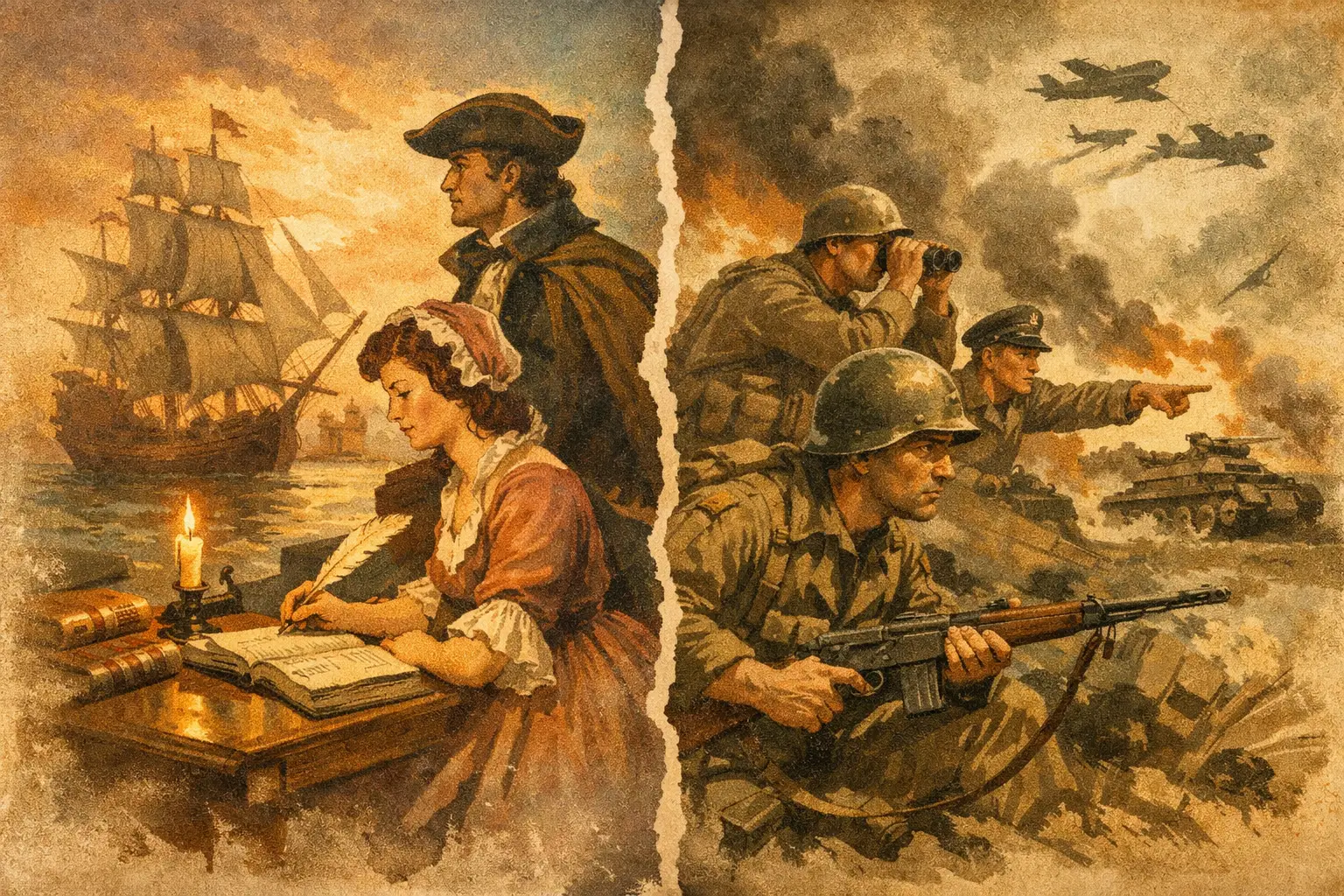
A battlefield can be mapped with precision and still remain morally obscure. Orders, troop movements, supply failures, casualty totals, and diplomatic correspondence tell us what happened. They do not always tell us what it cost a commander to issue an order, what a scout feared before delivering unwelcome intelligence, or how a court persuaded itself that war was necessary.
That is the central distinction in historical fiction versus military history. One discipline reconstructs conflict through evidence and analysis. The other enters the human interior of conflict through imagination disciplined by historical reality. Neither is a lesser form of engagement with the past. They ask different questions, and together they reveal more than either can hold alone.
What Military History Can Establish
Military history is accountable to the record. Its task is to examine armed conflict as an event shaped by material conditions, doctrine, institutions, geography, command structures, and political aims. A serious military history may explain why an army advanced, why a campaign stalled, how intelligence was gathered, and which strategic assumptions proved fatal.
Its strength is clarity. It can distinguish later legend from contemporary evidence. It can challenge the comforting idea that victory belonged to the more virtuous side, showing instead the effects of terrain, logistics, discipline, weather, industrial capacity, and error. Where historical memory often turns war into a pageant of famous names, military history restores friction: the missed message, the exhausted supply line, the unit committed too late, the ally whose interests no longer align.
This form is indispensable for readers who want to understand the mechanics of power. It teaches that no battle begins at the moment weapons meet. Preparation begins earlier, often in decisions that appear administrative or ceremonial: the storage of grain, the appointment of officers, the cultivation of informants, the reading of an opponent’s intentions.
Yet even exemplary military history faces a boundary. Documents preserve what institutions considered worth recording. They are often written by commanders, officials, chroniclers, or later interpreters with their own interests and blind spots. The archive can show a general’s decision, but it may not reveal the private calculation beneath it. It can record that a city surrendered. It cannot fully recover the quiet negotiation between fear, loyalty, hunger, and hope inside its walls.
What Historical Fiction Can Reveal
Historical fiction works in the space between the surviving record and the lived moment. Its responsibility is not to fabricate facts carelessly, but to make a credible human world from what history leaves incomplete. It gives a face to policy, a voice to doubt, and consequence to abstraction.
The best historical fiction does not merely dress modern characters in ancient clothing. It asks readers to inhabit a society governed by different assumptions about honor, kinship, law, religion, rank, and violence. It makes the past resistant. A ruler’s choice may be constrained by ritual. A commander may need to protect not only an army but the appearance of authority. A messenger may understand that truth, delivered at the wrong time, can become a weapon.
This is where fiction can illuminate strategy with unusual force. Strategy is rarely a diagram alone. It is the management of perception, morale, information, time, and desire. It depends on people who misunderstand one another, conceal their motives, and act under pressure with incomplete knowledge. A narrative can place the reader inside that uncertainty rather than describe it from a distance.
For readers drawn to Sun Tzu, this distinction matters. Principles such as foreknowledge, deception, preparation, and restraint can sound clean and absolute when presented as maxims. In a novel, they become difficult. Intelligence may demand betrayal. Restraint may look like weakness. A tactical victory may create a political disaster. The principle remains, but its cost comes into view.
Historical Fiction Versus Military History: Different Truths
The debate becomes unhelpful when it assumes that factual truth and imaginative truth are rivals. They are not. Military history asks, “What can we establish?” Historical fiction asks, “What might this have felt like, given what we know?” The first protects us from fantasy. The second protects us from the illusion that facts alone produce understanding.
A campaign history might show that a commander delayed battle to preserve his forces. Fiction can show the tension of that delay: restless officers, a frightened population, rivals interpreting caution as cowardice, and the leader who must hold to a longer calculation while others demand immediate action. The event is the same. The reader’s relation to it changes.
That difference also explains the risks. A novel can create powerful emotional certainty around scenes that cannot be verified. A persuasive character may cause readers to mistake invention for evidence. Conversely, military history can create a false sense of completeness when its formal analysis leaves out the experience of those with little power to document their lives.
The disciplined reader does not ask one form to become the other. Instead, they read with the proper expectation. Fiction should be judged by the intelligence of its reconstruction, the integrity of its imagined world, and the seriousness of its moral vision. Military history should be judged by its sources, reasoning, precision, and willingness to confront uncertainty.
Where Strategy Becomes Human
War is often discussed as a contest of force. The deeper contest is one of judgment. Leaders decide when to reveal strength, when to conceal weakness, when to wait, whom to trust, and what risks a state can bear. These choices belong to history, but they also belong to drama because they are made by human beings who cannot see the future.
This is why a strategically minded novel can offer something more than historical atmosphere. It can make governance visible as a field of competing pressures. It can show that power is not simply possessed. It must be maintained through credibility, information, discipline, and the ability to understand how others will interpret one’s actions.
In The Shuai-jan, the strategic inheritance associated with The Art of War is approached through this narrative dimension. Rather than treating strategy as a set of slogans for conquest, the novel places its ideas among the burdens of leadership, the uncertainty of intelligence, and the consequences of command. The result is not instruction disguised as fiction. It is fiction that recognizes how much is at stake when judgment fails.
Choosing the Right Book for the Question
Choose military history when you need a firm account of a campaign, a commander, a doctrine, or a political decision. It is the right form when the question concerns sequence, causation, evidence, and scale. It gives the reader a framework for seeing how war actually functions.
Choose historical fiction when you want to understand how systems of power enter private life. It is the right form when the question concerns motive, perception, loyalty, fear, and the moral weather surrounding a decision. A novel cannot settle a factual dispute, but it can make the meaning of a historical dilemma harder to evade.
For many readers, the richest approach is to move between the two. Read history to understand the ground beneath the story. Read fiction to feel the pressure of standing upon it. The first corrects romanticism; the second corrects detachment.
A record of war may teach us how armies moved. A serious novel can ask the more enduring question: what kind of mind believes it can move them, and what happens when that belief meets the limits of reality?
Leave a Reply