
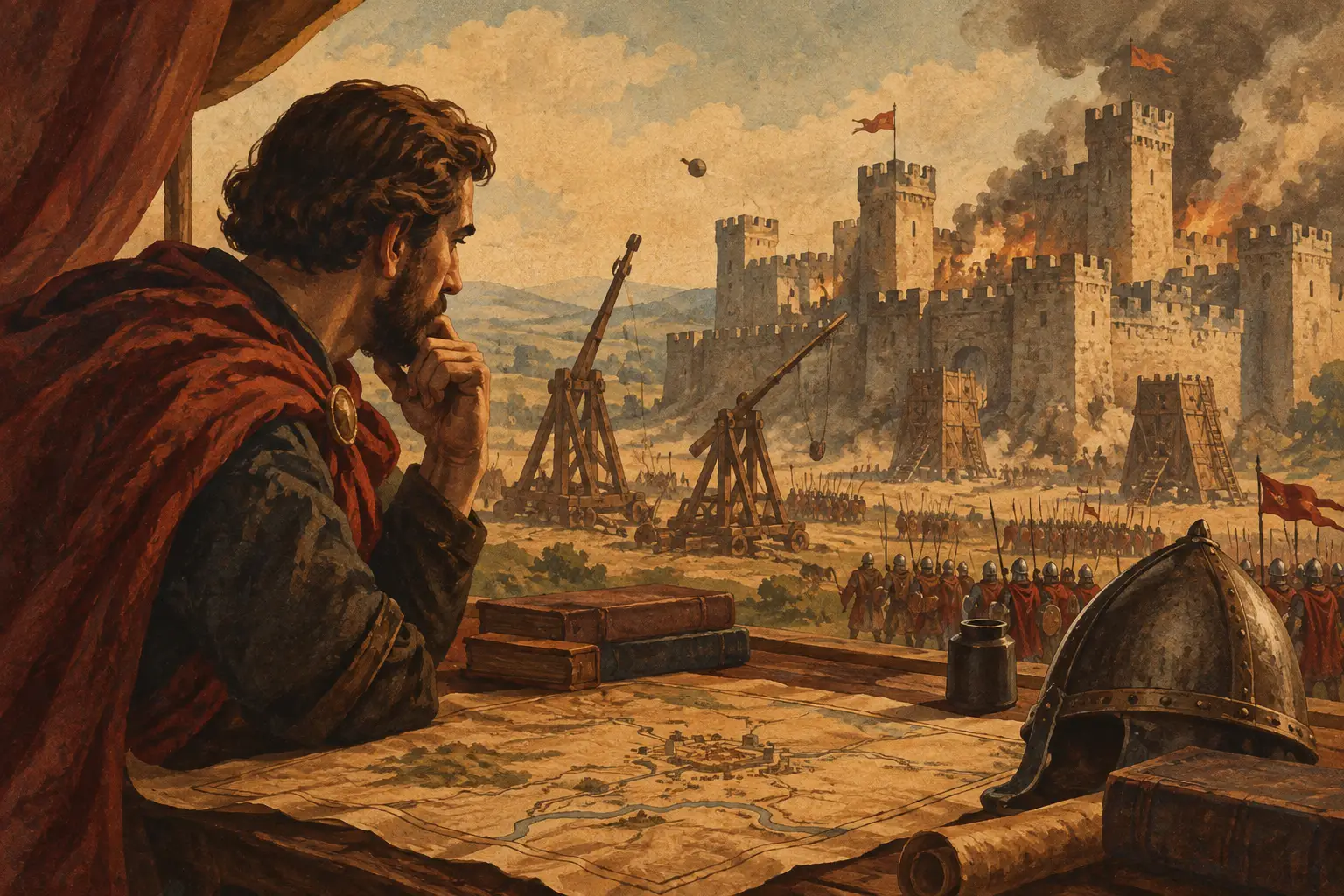
A siege begins when movement fails. Armies that once crossed open ground, scouts who read the horizon, and commanders who sought a decisive clash are drawn into a narrower contest: walls, gates, supply lines, rumors, weather, and time. The finest siege warfare novels understand that this is not merely a military situation. It is a pressure chamber for judgment.
Battle can obscure character in noise and velocity. A siege makes character visible. Every ration distributed, every message intercepted, every prisoner spared or executed, and every promise made to a frightened population becomes part of the campaign. For readers drawn to history, strategy, and the consequences of command, the genre offers something more demanding than spectacle. It asks what power means when force alone cannot settle the matter.
Why Siege Warfare Novels Carry Unusual Weight
A conventional battle novel may turn on courage in a single afternoon. Siege fiction operates on a different clock. Its drama grows through attrition, calculation, and the slow corrosion of certainty. The attacking force must sustain its own order while attempting to break another. The defenders must preserve morale while watching stores diminish and relief remain uncertain.
That prolonged strain gives the form unusual moral and political depth. A city under siege is never only a fortress. It is a government under examination. Its leaders must decide who receives food, which truths can be spoken, how dissent will be treated, and whether survival justifies acts that will poison the peace to come. Outside the walls, the besieging commander faces a parallel problem: how to keep an army disciplined when impatience, disease, and ambition begin to undermine the original plan.
The result is a form of historical fiction in which logistics becomes character. Grain is not background detail. It is policy. Water is not scenery. It is leverage. A damaged wall may matter less than a divided council, a bribed official, or a commander who has mistaken visible strength for actual control.
The Conflict Is Won Before the Assault
The popular image of a siege is the final breach: ladders against stone, fire in the streets, the desperate defense of a gate. Such scenes have their place, but they are rarely the deepest source of tension. A credible siege has usually been shaped well before the first assault.
Readers should look for novels that understand preparation as a form of action. How did the city stockpile provisions? Which roads were left open? Who knows the terrain beyond the walls? What intelligence does each side possess, and what false intelligence has it accepted because it was convenient? These questions reveal the strategic intelligence of the narrative itself.
A commander who charges at fortifications without understanding the defenders is not necessarily brave. He may be vain, politically trapped, or unable to imagine an alternative. Likewise, a governor who refuses to negotiate may be principled, but the novel should make clear what his principle costs those with no voice in the decision. Strong siege fiction does not confuse obstinacy with strength. It treats restraint, patience, deception, and selective force as serious instruments of power.
This is where the genre becomes especially compelling for readers of strategic thought. The central question is often not, “Who has the larger army?” It is, “Who understands the situation more clearly?” Numbers matter, but perception determines how numbers are used.
Intelligence Has a Human Face
In lesser fiction, intelligence is a convenient report delivered at the right moment. In serious siege narratives, it is unstable, partial, and expensive. Information arrives through scouts, deserters, merchants, captives, servants, emissaries, and frightened civilians. Every source carries a motive. Every message may have been shaped for the recipient’s eyes.
The best novels make this uncertainty felt. A commander must act before he knows enough, yet delay may create its own disaster. An intercepted letter may be genuine but misleading. A spy may provide accurate facts while guiding interpretation toward a fatal conclusion. Intelligence is therefore not simply the collection of secrets. It is the discipline of judging what a secret means.
That discipline extends beyond generals. A cook who notices reduced flour deliveries, a messenger who recognizes an altered seal, or a minor official who understands a ruler’s fear can become strategically significant. Siege warfare compresses social hierarchies. People who are ordinarily invisible may hold the knowledge on which a city’s survival depends.
What to Look for in Siege Warfare Novels
The most rewarding books in this tradition resist the temptation to make the walls the only source of drama. Stone fortifications matter, but the real siege occurs across several fronts at once: military, civic, psychological, and ethical.
First, look for a clear sense of competing objectives. An attacker may not need to destroy a city if surrender, political submission, or the removal of a rival ruler will achieve the larger aim. A defender may not need victory in the grand sense, only enough time for allies to arrive or an enemy coalition to fracture. When the goals are precise, every decision acquires consequence.
Second, consider whether the novel gives civilians genuine presence. A siege affects soldiers intensely, but it is civilians who endure the most pervasive vulnerability. They cannot easily leave. They are subject to requisition, panic, disease, and the arbitrary authority of those who claim to protect them. Fiction that treats them as scenery misses the political reality of encirclement.
Third, notice how the book handles time. Days should not pass as empty intervals between assaults. Time is the weapon both sides are trying to command. A week may strengthen a blockade, weaken a garrison, invite betrayal, exhaust the besiegers, or alter the weather so completely that an earlier plan becomes useless. In a well-constructed siege narrative, waiting is never passive.
Finally, seek moral complexity without moral fog. War fiction need not pretend that every decision is equally defensible. Yet it should recognize that leaders often choose among damaged options. The question is not whether a character remains pure under pressure. It is whether he or she sees the full cost of a chosen action and accepts responsibility for it.
The Limits of the Genre
Siege fiction is not automatically profound because it contains maps, ramparts, and military terminology. Excess technical detail can flatten the human stakes, while relentless suffering can become monotonous if the story offers no changing pattern of thought, loyalty, or power. The genre needs material reality, but it also needs interior movement.
There is another risk: the fantasy of perfect command. Readers who value strategy may enjoy a brilliant planner, yet a commander who foresees every betrayal and solves every problem too neatly diminishes the very conditions that make a siege compelling. Real strategic intelligence includes adaptation. It acknowledges friction, error, incomplete knowledge, and the possibility that an opponent may also be capable.
The strongest novels preserve this tension. They show that discipline is not omniscience and that control can be lost through one overlooked detail. A collapsed tunnel, a misread ally, an outbreak of illness, or an act of cruelty can reorganize an entire campaign. Strategy matters precisely because circumstances resist it.
A More Demanding Kind of Historical Fiction
For readers who approach historical fiction as an encounter with ideas, siege narratives offer rare density. They bring leadership out of abstraction and place it under conditions where every principle meets resistance. A ruler may speak of honor until hunger tests the city. A general may praise discipline until his own troops demand plunder. An adviser may argue for patience until delay threatens the people he serves.
This is part of the territory explored in The Shuai-jan by Ralph Srouji, where warfare is inseparable from intelligence, governance, perception, and the difficult art of command. Its interest lies not in presenting conflict as a sequence of victories, but in examining the calculations and human costs that precede decisive action.
The enduring appeal of siege warfare novels rests in this severe clarity. They remind us that power is not proven only by the ability to strike. It is revealed by the ability to prepare, to read motives, to preserve order, and to recognize when force serves a purpose and when it merely deepens ruin.
A worthwhile siege novel leaves the reader with more than the memory of a breached gate. It leaves a sharper awareness that every wall has two sides, every plan has a cost, and every leader is eventually measured by what remains when the noise of battle has stopped.
Leave a Reply