
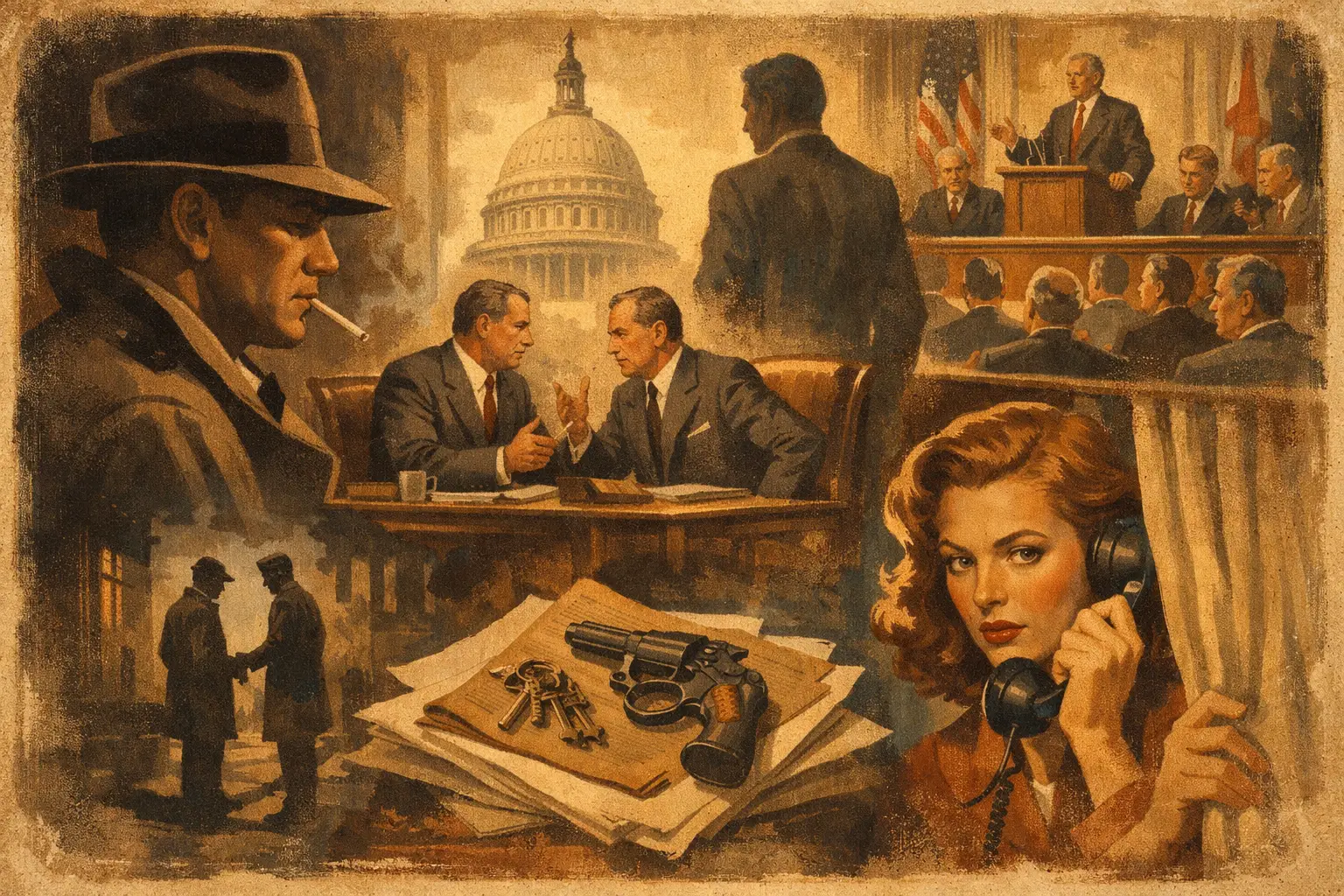
A kingdom rarely falls because one man is brave. It falls because advisers misread a rival, a ruler mistakes ceremony for loyalty, or a private grievance reaches the council chamber at the right moment. The best novels about political intrigue understand this severe reality: power is not merely possessed. It is interpreted, defended, concealed, and tested.
Political fiction at its finest does more than place conspiracies behind palace doors. It examines the disciplines that govern human conflict: intelligence, patience, rhetoric, leverage, fear, and the costly knowledge of when not to act. The following novels endure because they treat politics as an arena of consequence, where private character and public order continually shape one another.
What Makes Political Intrigue Worth Reading
A political intrigue novel is not simply a story with kings, elections, spies, or assassinations. Its essential question is more exacting: how does influence move when no one can fully trust what they see? The strongest works make institutions feel alive. Courts, parties, churches, armies, legislatures, and intelligence services become systems with their own pressures and blind spots.
These books also resist the easy comfort of moral simplicity. A capable leader may be ruthless. A principled reformer may be dangerously naive. A traitor may possess a clearer view of the state than those charged with defending it. Such tensions make political fiction valuable to readers interested in leadership and strategy, because it reveals that sound judgment is often forged under conditions of incomplete information.
12 Best Novels About Political Intrigue
1. I, Claudius by Robert Graves
Robert Graves turns imperial Rome into a machine of terror, vanity, and calculated survival. Told through the supposedly foolish Claudius, the novel follows the Julio-Claudian dynasty as succession becomes a contest of poison, performance, and family ambition.
Its lasting force lies in Claudius’s position at the edge of power. Because others underestimate him, he observes what stronger figures cannot: that authority depends as much on perception as force. It is a masterclass in the strategic value of appearing harmless.
2. Wolf Hall by Hilary Mantel
In Mantel’s Tudor England, Thomas Cromwell rises not by noble birth but by intellectual mobility. He reads rooms, identifies incentives, and recognizes that Henry VIII’s court is governed by appetite as much as law.
Wolf Hall is especially sharp on administration. Cromwell’s power comes from understanding paperwork, networks, timing, and language. The novel shows that political transformation is not achieved by grand declarations alone. It requires people who can make a new order function after the old one has been broken.
3. The Leopard by Giuseppe Tomasi di Lampedusa
Set during the Italian unification movement, The Leopard follows Prince Fabrizio Salina as the world that sustained his class begins to disappear. The novel’s famous insight is ruthless: those who wish things to remain as they are may need to accept that everything changes.
This is intrigue on a civilizational scale. Rather than centering on a single plot, Lampedusa studies adaptation itself. The old elite, the rising bourgeoisie, and the new political order maneuver around one another, each trying to preserve status under altered conditions.
4. All the King’s Men by Robert Penn Warren
Willie Stark’s ascent from rural idealist to commanding governor forms the center of this American classic. Through the reflective voice of Jack Burden, the novel observes how reform, ambition, and corruption become entangled.
Warren does not allow readers to dismiss Stark as merely a demagogue. His power emerges from genuine public grievance, then expands through coercion and compromise. The result is a hard examination of whether political effectiveness can remain clean once it enters the machinery of power.
5. The Quiet American by Graham Greene
Graham Greene sets this quiet, devastating novel in French-controlled Vietnam, where colonial decay and Cold War certainty collide. The narrator, Thomas Fowler, watches Alden Pyle bring a dangerous faith in abstract political solutions to a country he barely understands.
The intrigue here is moral before it is procedural. Intelligence fails when it is filtered through ideology, and good intentions become instruments of violence when they refuse to see local reality. Few novels expose the strategic cost of arrogance with greater precision.
6. The Manchurian Candidate by Richard Condon
Richard Condon’s thriller imagines a decorated American soldier shaped into a weapon for foreign manipulation. Its atmosphere is fevered, but its central concern remains serious: what happens when political legitimacy is attacked through psychology, spectacle, and hidden control?
The novel is less subtle than some entries here, yet that intensity is part of its power. It understands that a state can be threatened not only by armies at its border but by compromised judgment at its center.
7. The Sympathizer by Viet Thanh Nguyen
The unnamed narrator of The Sympathizer is a communist spy embedded among South Vietnamese refugees in the United States. He is divided by culture, allegiance, and conscience, forced to report on people whose losses he genuinely understands.
Nguyen gives political intrigue an interior dimension. Espionage is not only the transfer of secrets but the slow fracture of identity. The novel’s satirical intelligence makes its tragedy sharper, revealing how ideological conflict can demand performances that eventually consume the performer.
8. A Conspiracy of Paper by David Liss
Set in eighteenth-century London, David Liss’s novel combines financial warfare, class prejudice, and state power. Benjamin Weaver investigates an apparent suicide and discovers that commerce is never separate from politics when fortunes can alter the direction of governments.
Its particular strength is its attention to markets as instruments of influence. Political maneuvering does not always begin in a parliament or palace. It can begin with a rumor, a debt, a manipulated price, or a well-placed act of financial sabotage.
9. The Power and the Glory by Graham Greene
In an unnamed Mexican state, a fugitive priest continues his ministry while an anti-clerical government pursues him. The conflict is small in scale but profound in implication: the state seeks order through eradication, while faith survives through flawed human beings.
Greene refuses to make either side simple. The priest is compromised, the lieutenant is disciplined, and both are shaped by a struggle larger than themselves. This is political fiction that recognizes conviction as both a source of strength and a source of cruelty.
10. The Amazing Adventures of Kavalier & Clay by Michael Chabon
Though often remembered for its comic-book imagination, Chabon’s novel contains a rich portrait of propaganda, wartime culture, immigration, and the uses of myth. Its characters confront a world in which political violence reaches across borders and enters private life.
The intrigue is less institutional than in a court drama, but the novel is alert to the relationship between narrative and power. It asks who gets to shape public imagination, and what creative work can accomplish when formal political action feels insufficient.
11. Lincoln by Gore Vidal
Gore Vidal’s Lincoln portrays the Civil War presidency as an exercise in controlled pressure. The president must manage generals, cabinet members, abolitionists, Democrats, foreign powers, and a public exhausted by war.
The novel is invaluable for its refusal to reduce leadership to a single heroic will. Lincoln’s authority depends on coalition management, restraint, and an acute awareness of timing. His decisions matter not only because they are morally charged, but because they must survive institutional resistance.
12. The Shuai-jan by Ralph Srouji
The Shuai-jan approaches political and military conflict through the strategic world associated with Sun Tzu. Rather than treating strategy as a collection of maxims, it places intelligence, preparation, governance, and warfare within a dramatized historical narrative.
For readers drawn to political intrigue as an examination of disciplined judgment, this approach has particular force. The central concern is not spectacle for its own sake, but the human consequences of foresight, deception, command, and restraint.
How to Choose the Right Political Novel
The best choice depends on the form of power that most interests you. Readers drawn to courts and dynasties should begin with I, Claudius or Wolf Hall. Those concerned with democratic institutions and public corruption may find All the King’s Men or Lincoln more immediate. For intelligence work, ideological conflict, and divided loyalty, The Quiet American and The Sympathizer offer deeper unease than conventional spy fiction.
There is also a meaningful distinction between novels about the seizure of power and those about its maintenance. The first often move quickly through coups, elections, conspiracies, and revolutions. The second are usually more patient, concerned with administration, compromise, and the quiet erosion of authority. Neither is inherently superior. The question is whether one seeks the drama of ascent or the harder study of responsibility after victory.
Political intrigue matters because it restores weight to decisions that can otherwise seem abstract. A vote, a marriage, a military order, a leaked message, or an act of silence can redirect the lives of thousands. Read these novels not merely for plots of betrayal, but for their deeper lesson: power is most dangerous when those who wield it no longer understand the forces they have set in motion.
Leave a Reply